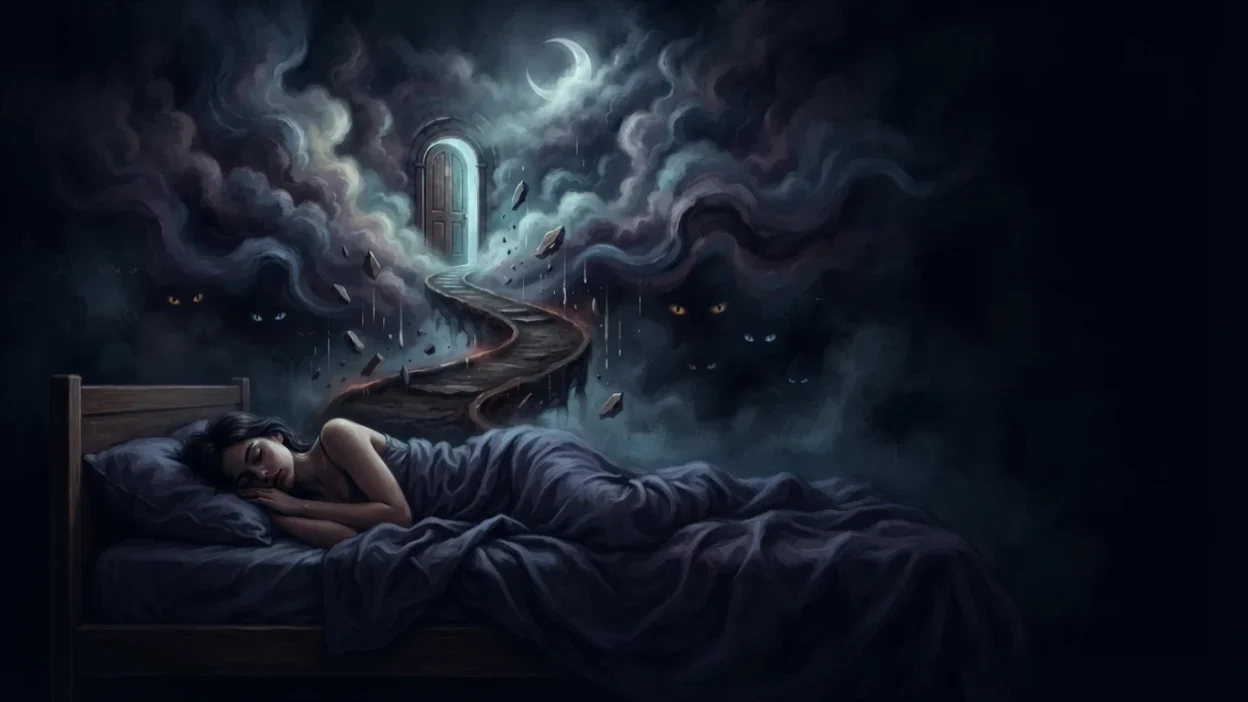
Nightmare symbolism can turn frightening dreams into meaningful reflections of emotions, fears, conflicts, and life changes. While a nightmare may feel disturbing, its imagery often represents something deeper than the dream itself. From being chased or trapped to falling, losing someone, or facing a mysterious threat, nightmares can mirror concerns that the waking mind has not fully processed.
Understanding nightmare symbolism does not mean every frightening dream has a fixed or supernatural meaning. The same image can represent different things for different people. Personal experiences, emotions, beliefs, memories, and circumstances all influence how a nightmare should be understood.
Nightmare Symbolism Meaning (Clear Definition)
Nightmare symbolism is the interpretation of frightening dream images, situations, and emotions as representations of fears, stress, unresolved conflicts, change, or hidden concerns.
Nightmares often use dramatic images because dreams communicate through emotion and symbolism rather than ordinary conversation. A locked door may symbolize feeling blocked, while falling might represent insecurity or a loss of control.
Common symbolic themes include:
- Being chased: avoidance, fear, or pressure
- Falling: insecurity, instability, or loss of control
- Being trapped: helplessness or restricted choices
- Death: transformation, endings, or fear of loss
- Darkness: uncertainty, mystery, or the unknown
- Teeth falling out: vulnerability, embarrassment, or concerns about appearance
- Water or drowning: overwhelming emotions or emotional pressure
- Monsters: exaggerated fears or problems that feel threatening
The emotional experience is often more important than the specific image. Ask yourself what you felt during the nightmare and what situation in your waking life creates a similar feeling.
What Does Nightmare Symbolism Represent?
Nightmare symbolism commonly represents fear, anxiety, vulnerability, uncertainty, emotional conflict, suppressed feelings, and major transitions.
A nightmare may appear when something in life feels unresolved. Difficult relationships, academic or professional pressure, uncertainty about the future, grief, major changes, or internal conflict can influence dream content.
However, nightmares do not always represent something negative. Sometimes frightening imagery reflects the mind confronting change.
For example, dreaming about the destruction of a house could symbolize the end of an old stage of life rather than an actual disaster. A frightening transformation may represent personal growth that feels uncomfortable before it becomes empowering.
| Nightmare SymbolPossible Symbolic Meaning | |
|---|---|
| Being chased | Avoidance, pressure, fear |
| Falling | Instability, insecurity, loss of control |
| Drowning | Emotional overwhelm |
| Darkness | Uncertainty or the unknown |
| Death | Endings, transformation, renewal |
| Being trapped | Helplessness or limitation |
| Monster | A powerful fear or unresolved problem |
| Fire | Anger, destruction, purification, transformation |
These interpretations are possibilities rather than universal rules.
Spiritual Meaning of Nightmare Symbolism
From a spiritual perspective, nightmares are sometimes viewed as messages about inner growth, emotional cleansing, spiritual uncertainty, or the need to confront hidden fears.
Some spiritual traditions interpret disturbing dreams as invitations to examine one’s thoughts and behavior. A nightmare can encourage self-reflection by bringing uncomfortable emotions into awareness.
Darkness, for example, may symbolize the unknown parts of the self. A frightening journey may represent a difficult spiritual transition. A threatening figure might symbolize an inner obstacle rather than an external force.
It is also important to approach spiritual interpretations thoughtfully. A frightening dream does not automatically indicate a supernatural warning, spiritual attack, or prediction of future events.
Instead, the most useful spiritual question may be:
What is this dream encouraging me to understand, release, or face?
Biblical / Religious Meaning of Nightmare Symbolism
In biblical and religious traditions, dreams can sometimes carry important meaning, although the Bible does not provide a universal symbolic dictionary for nightmares.
Several biblical accounts describe dreams as significant experiences. Joseph, for example, interpreted dreams in Genesis, while dreams and visions appear in several other biblical narratives.
Religious interpretations often emphasize discernment. A disturbing dream may encourage prayer, reflection, repentance, trust, or awareness, but not every nightmare should automatically be treated as divine communication.
Within broader religious traditions, frightening dreams have also been understood in different ways. Some cultures view them as warnings, while others see them as expressions of spiritual struggle or ordinary human fears.
A balanced interpretation considers faith, personal circumstances, emotional state, and the specific context of the dream rather than assuming one meaning applies to everyone.
Nightmare Symbolism in History and Culture
People have tried to understand frightening dreams for thousands of years.
Ancient civilizations often connected dreams with gods, spirits, omens, healing, and messages from another realm. In some cultures, dreams were treated as meaningful experiences that could provide guidance about personal or communal concerns.
The concept of the nightmare itself has also developed through folklore. European traditions sometimes described frightening nighttime experiences as the work of supernatural beings or oppressive spirits.
Over time, cultural explanations gradually expanded to include psychological and physiological perspectives.
Today, nightmares can be understood through several lenses, including:
- Folklore and mythology
- Religious belief
- Psychology
- Neuroscience
- Personal symbolism
- Literature and popular culture
This cultural history shows why nightmare symbolism can vary significantly between societies.
Nightmare Symbolism in Literature and Art
Nightmares have played a powerful role in literature and visual art because they allow creators to represent fears that are difficult to express directly.
Dark landscapes, monsters, distorted faces, shadows, storms, and impossible spaces often symbolize psychological tension. Writers and artists can use nightmare imagery to explore guilt, isolation, mortality, madness, desire, and uncertainty.
In literature, a nightmare can also foreshadow an important event or reveal a character’s internal conflict. The dream may function almost like a window into the character’s subconscious.
Artists have similarly used disturbing dream imagery to challenge viewers. Rather than simply creating fear, nightmare-inspired art can ask deeper questions about identity, society, death, memory, and human nature.
The enduring appeal of nightmare imagery comes partly from its ability to make invisible emotions visible.
Dream Meaning of Nightmare Symbolism
The dream meaning of nightmares depends heavily on the dreamer’s personal experiences and emotional response.
A nightmare about falling may indicate uncertainty for one person but excitement about change for another. A dream about losing someone could reflect grief, fear of separation, or simply memories connected with that person.
When interpreting a nightmare, consider these questions:
- What was the strongest emotion in the dream?
- What happened immediately before the frightening moment?
- Did the dream remind you of a real-life situation?
- Who appeared in the dream?
- What symbols or objects stood out?
- Have you experienced similar dreams before?
- What is currently causing stress or uncertainty in your life?
The emotional meaning of dreams is often more revealing than relying on a generic dream dictionary.
For example, being chased may not literally mean you are running from something. It might symbolize avoiding an uncomfortable conversation, responsibility, decision, memory, or emotion.
Modern Meaning of Nightmare Symbolism
In modern life, nightmares are often connected with stress, emotional overload, major changes, fear, and unresolved experiences.
Digital media can also influence dream imagery. Movies, social media, news, games, and stressful online experiences can provide images that later appear in dreams.
Modern psychology generally encourages people to look at nightmares in context rather than treating individual symbols as universal predictions.
A recurring nightmare may be especially meaningful because repetition can highlight an unresolved emotional theme. Instead of asking only, “What does this symbol mean?” consider asking, “Why does this feeling keep returning?”
This approach can turn nightmare interpretation into a useful form of self-reflection.
Common Nightmare Themes and Their Possible Meanings
Being chased may reflect avoidance, pressure, or fear.
Being unable to move may symbolize helplessness, restriction, or vulnerability.
Losing your way can represent uncertainty about direction or important decisions.
Being attacked may reflect feeling threatened, criticized, or emotionally overwhelmed.
A collapsing building may symbolize instability or the breakdown of something once considered secure.
A loved one disappearing may represent fear of separation, change, or loss.
A monster can represent a problem that has become larger and more frightening in the mind.
Remember that these are symbolic possibilities, not guaranteed interpretations.
How to Interpret Nightmare Symbolism
A useful interpretation begins with the dreamer’s own life rather than a fixed list of meanings.
Try this simple process:
- Write down the nightmare as soon as you remember it.
- Identify the strongest emotion, such as fear, shame, sadness, anger, or helplessness.
- List the major symbols that appeared.
- Connect each symbol with personal experiences rather than assuming a universal definition.
- Look for recurring themes across multiple dreams.
- Consider recent changes or stressors in waking life.
- Ask what the dream might be helping you notice.
This method shifts attention from fear toward understanding.
A nightmare does not necessarily predict something bad. Sometimes it simply reveals an emotion that deserves attention.
Are Nightmares Always Negative?
No. Although nightmares are unpleasant, their symbolism is not necessarily negative.
A frightening dream can represent the end of an old pattern, the confrontation of a fear, or the beginning of emotional change. In symbolic terms, destruction can sometimes precede rebuilding.
The nightmare may therefore be less about danger and more about awareness.
What initially appears frightening can become meaningful when viewed as an invitation to understand yourself more honestly.
Why Do We Have Symbolic Nightmares?
Nightmares may arise for many reasons, including stress, emotional experiences, frightening memories, disrupted sleep, and significant life changes.
Sometimes the brain combines unrelated memories and emotions into unusual dream narratives. The result can feel mysterious because dreams do not always follow the logic of waking life.
Recurring nightmares may deserve additional attention, especially when they consistently disturb sleep or affect daily well-being.
The important point is that a nightmare is an experience—not necessarily a prophecy.
Frequently Asked Questions About Nightmare Symbolism
What is the spiritual meaning of a nightmare?
Spiritually, a nightmare may symbolize inner conflict, fear, transformation, uncertainty, or a need for self-reflection. Different spiritual traditions interpret dreams differently, so personal beliefs and circumstances matter.
What does it mean when you keep having the same nightmare?
Recurring nightmares may point to a repeated emotional theme, unresolved concern, or ongoing stress. Looking for patterns in the feelings and situations surrounding the dream can provide useful insight.
Are nightmares signs of something bad happening?
Not necessarily. Nightmares commonly reflect emotions, memories, fears, or stress rather than predicting future events.
What does being chased in a nightmare symbolize?
Being chased often symbolizes avoidance, pressure, fear, or a situation you feel unprepared to confront. The identity of the pursuer and your emotions during the dream can provide additional context.
Can nightmare symbolism be positive?
Yes. A frightening dream can symbolize personal growth, emotional release, transformation, or the recognition of something that needs attention.
Conclusion
Nightmare symbolism offers a fascinating way to explore fear, uncertainty, emotional conflict, and transformation. A nightmare may frighten you, but its deeper message can sometimes encourage awareness and personal growth.
Rather than fearing every disturbing dream, consider what emotion it brings to the surface. Sometimes the darkest dream simply points toward something within you that is ready to be understood.

Miles Arthur is a passionate content writer at Symblosim.com, specializing in symbol meanings, cultural symbolism, spiritual interpretations, and historical signs. He creates informative articles that help readers understand the deeper significance of symbols.