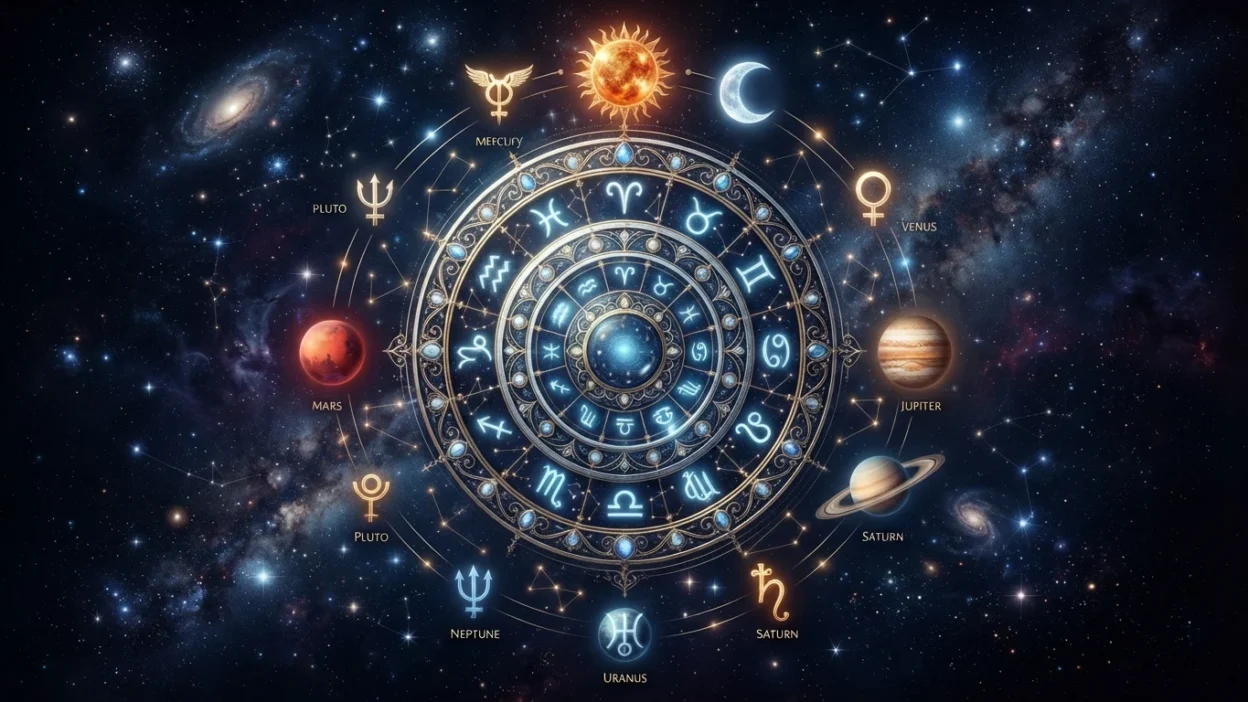
Astrology symbolism is the system of meanings associated with planets, zodiac signs, houses, elements, and celestial movements. For thousands of years, people have looked to the sky not only to understand time and seasons but also to explore personality, destiny, relationships, and spiritual questions.
From the fiery symbolism of Aries to the mysterious influence traditionally associated with Pluto, astrology uses celestial images as a symbolic language. Whether you view astrology as a spiritual practice, cultural tradition, or reflective tool, its symbols offer a fascinating way to explore human experience.
Astrology Symbolism Meaning (Clear Definition)
Astrology symbolism refers to the meanings traditionally assigned to celestial bodies, zodiac signs, houses, aspects, and other components of an astrological chart.
In simple terms, astrological symbols act like a visual language. Each symbol represents a particular quality, theme, or area of life.
For example:
- The Sun often symbolizes identity, vitality, confidence, and self-expression.
- The Moon represents emotions, instincts, memory, and inner life.
- Mercury is associated with communication, thought, and learning.
- Venus symbolizes love, attraction, beauty, and values.
- Mars represents action, desire, courage, and assertion.
- Jupiter traditionally symbolizes growth, wisdom, abundance, and opportunity.
- Saturn represents discipline, responsibility, limits, and maturity.
These meanings can change depending on the zodiac sign, house, and relationships between planets in a birth chart.
What Does Astrology Symbolism Represent?
At its heart, astrology symbolism represents the human desire to understand life through patterns found in the cosmos.
Astrological symbols can represent:
| Symbolic ElementTraditional Meaning | |
|---|---|
| Sun | Identity, vitality, purpose |
| Moon | Emotions, instincts, security |
| Mercury | Communication, intellect, learning |
| Venus | Love, beauty, attraction, values |
| Mars | Energy, courage, desire, action |
| Jupiter | Growth, wisdom, abundance |
| Saturn | Discipline, responsibility, boundaries |
| Uranus | Change, freedom, innovation |
| Neptune | Dreams, imagination, spirituality |
| Pluto | Transformation, power, renewal |
| Zodiac signs | Personality qualities and archetypes |
| Houses | Different areas of human life |
| Elements | Fundamental qualities and temperaments |
Zodiac Signs as Symbols
The twelve zodiac signs are among the most recognizable forms of astrology symbolism.
Each sign has traditional characteristics:
- Aries — courage, initiative, independence
- Taurus — stability, patience, values
- Gemini — communication, curiosity, adaptability
- Cancer — emotion, home, nurturing
- Leo — creativity, confidence, self-expression
- Virgo — analysis, service, practicality
- Libra — balance, relationships, harmony
- Scorpio — transformation, intensity, depth
- Sagittarius — exploration, freedom, philosophy
- Capricorn — ambition, discipline, achievement
- Aquarius — originality, independence, humanitarian ideals
- Pisces — imagination, compassion, intuition
These interpretations are traditional astrological associations rather than scientifically established personality measurements.
Spiritual Meaning of Astrology Symbolism
Spiritually, astrology symbolism can represent the relationship between the individual and the larger universe.
Many people use astrological symbols for reflection. A birth chart may become a symbolic map through which someone considers personal strengths, challenges, relationships, ambitions, and recurring life themes.
The spiritual meaning of astrology symbolism often includes:
- Self-discovery
- Personal transformation
- Inner awareness
- Connection with nature
- Cycles of life
- Intuition and reflection
- A sense of cosmic order
For some people, astrology encourages the idea that life moves through cycles rather than existing as a series of isolated events. Planetary movements and seasonal patterns can therefore become metaphors for growth, endings, beginnings, and change.
Biblical / Religious Meaning of Astrology Symbolism
The relationship between astrology and religion is complex.
In Christianity and several other religious traditions, astrology has often been distinguished from the simple observation of celestial bodies. Religious texts may describe stars, the Sun, Moon, and heavens as part of creation while also warning against practices involving divination or attempting to predict destiny through celestial signs.
For this reason, astrology symbolism does not have one universal religious meaning.
Historically, however, celestial imagery has played an important role in many religious cultures. Stars can symbolize guidance, divine creation, eternity, or heavenly order. The movement of celestial bodies has also been used to establish calendars, festivals, seasons, and sacred times.
It is therefore useful to distinguish astronomy, religious celestial symbolism, and astrology, since they have overlapping histories but different purposes.
Astrology Symbolism in History and Culture
Astrology has a long and varied cultural history.
Ancient civilizations observed the heavens to track seasons, agricultural cycles, calendars, and important celestial events. Over time, these observations became connected with symbolic systems involving planets, constellations, and zodiac signs.
Babylonian traditions played an important role in the development of early astrological practices. Greek and Hellenistic thinkers later contributed concepts that influenced Western astrology, while astrology also developed distinctive traditions in South Asia and other regions.
The symbolism of the zodiac has therefore never belonged to a single culture.
Across history, celestial symbols have appeared in:
- Calendars and timekeeping
- Religious traditions
- Royal courts
- Architecture
- Manuscripts
- Decorative arts
- Personal talismans
- Scientific and philosophical texts
- Cultural storytelling
The continued survival of these symbols shows how strongly humans have connected the sky with meaning and imagination.
Astrology Symbolism in Literature and Art
Astrology symbolism has provided writers and artists with a rich collection of metaphors.
The Sun can symbolize life or authority. The Moon may represent mystery, emotional change, or the unconscious. Saturn can suggest restriction, age, or time, while Venus may evoke beauty, love, and desire.
In literature, zodiac symbolism can also help characterize people or create a particular atmosphere.
An author might describe a character as having a “Leo-like” confidence without directly mentioning astrology. A mysterious Moon can become a symbol of hidden emotions, while a changing sky can suggest uncertainty or transformation.
Artists have similarly used planets, constellations, zodiac wheels, and celestial imagery to explore themes such as destiny, mortality, love, power, and the relationship between humanity and the universe.
Dream Meaning of Astrology Symbolism
Dreams involving astrology can have highly personal meanings.
Seeing zodiac signs, planets, stars, horoscopes, or birth charts in a dream may symbolize curiosity about identity, destiny, relationships, or the future.
Common interpretations include:
- Dreaming of stars — hope, ambition, guidance, or distant possibilities.
- Dreaming of the Moon — emotions, intuition, mystery, or inner change.
- Dreaming of the Sun — confidence, clarity, vitality, or recognition.
- Dreaming of a zodiac sign — identification with particular personality qualities.
- Dreaming of a horoscope — uncertainty about the future or a desire for direction.
- Dreaming of a birth chart — self-examination and curiosity about personal patterns.
Dream symbolism is subjective, so the emotions and circumstances surrounding the dream are often more meaningful than any universal interpretation.
Modern Meaning of Astrology Symbolism
Today, astrology symbolism exists at the intersection of spirituality, entertainment, identity, psychology-inspired self-reflection, and popular culture.
Zodiac signs appear everywhere, from social media profiles and jewelry to tattoos, artwork, fashion, and personalized gifts.
For many people, astrology offers a vocabulary for discussing personality and relationships. Others enjoy it primarily as mythology, symbolism, or a creative way to reflect on life.
Modern astrology symbolism can therefore mean different things to different people. Its value often comes from the questions it encourages rather than from treating symbolic interpretations as scientifically proven predictions.
Astrology Symbolism in Everyday Life
People commonly encounter astrological symbolism through:
- Birth charts
- Zodiac jewelry
- Horoscope columns
- Astrology apps
- Zodiac artwork
- Tattoos
- Spiritual practices
- Personality discussions
- Relationship compatibility readings
- Social media content
The popularity of these symbols demonstrates how ancient celestial imagery continues to adapt to modern culture.
Why Is Astrology Symbolism Still Important?
Astrology symbolism remains powerful because symbols allow complex ideas to be expressed simply.
A planet can represent an inner quality. A zodiac sign can become an archetype. A house can represent an area of life. Together, these symbols create a framework for discussing experiences that can otherwise be difficult to describe.
Even people who do not believe astrology predicts events may appreciate its mythology and symbolism.
Its enduring appeal ultimately comes from a timeless human question: What does our place in the universe mean?
FAQs About Astrology Symbolism
What is the main meaning of astrology symbolism?
Astrology symbolism is a traditional system that gives symbolic meanings to planets, zodiac signs, houses, and celestial relationships. It is often used to explore personality, life themes, and spiritual ideas.
What do zodiac signs symbolize?
Zodiac signs traditionally symbolize different personality qualities and archetypal patterns. Each sign is associated with particular elements, characteristics, and planetary rulerships.
What does the Sun symbolize in astrology?
The Sun traditionally symbolizes identity, vitality, confidence, purpose, and self-expression. In a birth chart, it is commonly associated with the sense of self.
What does the Moon symbolize in astrology?
The Moon is traditionally associated with emotions, instincts, memory, comfort, and the inner self. Its symbolism often relates to how a person experiences and responds emotionally.
Is astrology symbolism religious?
Astrology symbolism is not inherently part of one religion. Different cultures and religions have interpreted celestial bodies in different ways, and some religious traditions accept certain forms of celestial observation while rejecting divination.
Conclusion
Astrology symbolism offers a fascinating symbolic language for exploring identity, emotions, relationships, transformation, and humanity’s connection with the cosmos. From ancient zodiac traditions to modern personal reflection, its symbols continue to inspire curiosity and imagination.
Whether approached as spirituality, cultural history, mythology, or personal symbolism, astrology reminds us that humans have always looked toward the sky while searching for meaning on Earth.