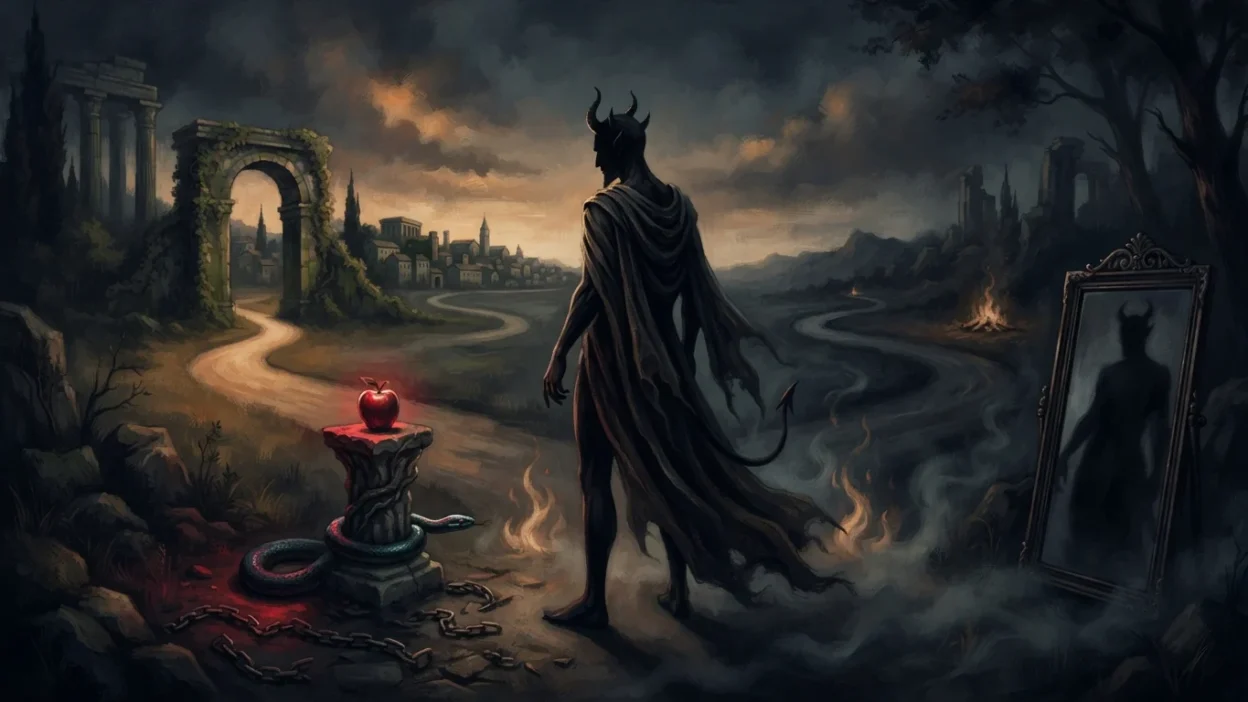
Devil symbolism has appeared throughout religion, mythology, literature, art, and popular culture for centuries. The devil is often portrayed as a figure of temptation, evil, rebellion, deception, fear, or moral conflict.
Yet the symbol is more complex than simply representing evil. In different traditions and stories, the devil can represent temptation, forbidden knowledge, personal freedom, pride, chaos, shadow aspects of human nature, or the consequences of poor choices.
Understanding devil symbolism requires looking at its context. A religious interpretation may differ greatly from a literary or psychological one. In one story, the devil may represent an actual supernatural adversary; in another, the figure may simply symbolize a person’s inner struggle between desire and conscience.
Devil Symbolism Meaning (Clear Definition)
Devil symbolism refers to the use of the devil or a devil-like figure to represent evil, temptation, deception, rebellion, moral conflict, destructive desire, or opposition to divine or social order.
The devil is one of the most recognizable symbols of moral opposition. It is often placed in contrast with figures or ideas representing goodness, holiness, truth, or divine authority.
Common meanings associated with devil symbolism include:
- Temptation
- Evil
- Deception
- Rebellion
- Pride
- Chaos
- Fear
- Forbidden desire
- Moral conflict
- Destructive behavior
- Freedom from authority
- Consequences
The meaning is not always negative in literature and popular culture. Some modern interpretations portray the devil as a rebellious outsider, a trickster, or a figure who challenges established authority.
Devil Symbolism and Moral Conflict
One of the most important meanings of the devil is moral temptation.
The devil may offer something attractive while hiding its consequences. This creates a symbolic conflict between immediate desire and long-term responsibility.
The figure therefore represents a question that many people understand:
Should we choose what feels good now, or what we believe is right?
What Does Devil Symbolism Represent?
Devil symbolism can represent several different aspects of human behavior and society.
Temptation
Temptation is perhaps the most familiar meaning.
A devil may offer wealth, power, pleasure, knowledge, or success in exchange for something valuable.
Symbolically, this represents the struggle between desire and restraint.
Evil
In many religious traditions, the devil represents opposition to goodness and divine order.
The symbol can therefore embody destructive actions, corruption, cruelty, hatred, and moral wrongdoing.
Deception
The devil is frequently portrayed as clever or persuasive.
This makes the figure a symbol of deception, manipulation, false promises, and appearances that hide unpleasant consequences.
Rebellion
Another important interpretation is rebellion against authority.
A devil figure may represent someone who refuses to obey established rules, institutions, traditions, or moral expectations.
This interpretation can be negative or positive depending on the story.
Pride
Pride is another recurring association.
A character who places personal ambition above moral responsibility may be described through devil symbolism.
The symbol can therefore warn against excessive arrogance and the belief that one’s desires are more important than everyone else’s well-being.
Chaos and Disorder
The devil may also symbolize forces that disrupt order.
Where angels or divine figures represent harmony and structure, the devil may represent chaos, conflict, disorder, and uncertainty.
Forbidden Knowledge
In some literary and cultural interpretations, the devil is connected with knowledge that people are not supposed to possess.
This makes devil symbolism related to curiosity, forbidden questions, intellectual rebellion, and the desire to cross boundaries.
Spiritual Meaning of Devil Symbolism
The spiritual meaning of devil symbolism often centers on temptation, moral testing, spiritual conflict, and the struggle between destructive and constructive forces.
The devil may symbolize:
- Temptation
- Spiritual opposition
- Moral testing
- Deception
- Pride
- Fear
- Separation from the divine
- Inner conflict
- Consequences of harmful choices
- The shadow side of human nature
The Devil as a Test
In some religious and spiritual interpretations, encounters with evil or temptation can function as tests of character.
The important question is not simply whether temptation exists, but how a person responds to it.
This gives devil symbolism a potentially constructive lesson: difficult choices can reveal values, priorities, and character.
The Devil and Inner Conflict
Outside literal religious belief, the devil can symbolize the darker parts of human psychology.
Anger, greed, jealousy, selfishness, resentment, and destructive desires may metaphorically become a person’s “inner devil.”
This interpretation does not necessarily mean that people are inherently evil. Instead, it recognizes that human beings can experience conflicting impulses.
The Devil as a Warning
Devil imagery often works as a warning.
A devil appearing in a story or artwork may encourage people to think carefully about choices, consequences, manipulation, or uncontrolled desire.
Biblical / Religious Meaning of Devil Symbolism
The meaning of the devil differs among religious traditions, and biblical terminology is more complex than the modern popular image of a red figure with horns and a pitchfork.
The Devil in Christianity
In Christian tradition, the devil is commonly associated with Satan, the adversary, tempter, and opponent of God.
The New Testament presents Satan as a tempter and adversarial spiritual figure. Christian teachings commonly associate the devil with deception, sin, temptation, and opposition to God’s purposes.
The familiar visual image of the devil developed over centuries through theology, art, folklore, and literature rather than coming directly from a single biblical description.
Satan and the Tempter
In Christian interpretation, Satan’s role as tempter makes devil symbolism strongly connected with moral choice.
The temptation narrative involving Jesus in the wilderness is particularly important to Christian understandings of resisting temptation and remaining faithful.
The Devil and Evil
Christian symbolism frequently places the devil in opposition to God.
This creates a symbolic contrast:
God → Goodness, truth, life, holiness
Devil → Temptation, deception, sin, opposition
This contrast has strongly influenced Western art and storytelling.
Judaism
The concept of satan in the Hebrew Bible has a more nuanced history than the later popular image of Satan as an independent ruler of hell.
The Hebrew term can carry the sense of an adversary or accuser. Later Jewish traditions developed different ideas about evil, spiritual beings, and Satan.
It is therefore important not to treat all Jewish and Christian interpretations as identical.
Islam
Islam has its own important concept of Iblis, who refuses God’s command and becomes associated with opposition and temptation.
Iblis is connected with the broader concept of shaytan, referring to a tempter or adversarial force.
Islamic teachings distinguish these concepts from the Christian theological development of Satan, even though there are thematic similarities involving temptation and disobedience.
Devil Symbolism in History and Culture
The modern image of the devil developed through many historical influences.
Religious teachings, folklore, mythology, medieval art, theater, literature, and popular culture all contributed to the familiar devil figure.
Horns and Hooves
The devil’s horns, hooves, and animal-like features became especially common in European art.
These characteristics were influenced in part by older pagan imagery and artistic traditions. Over time, artists used animal features to visually communicate wildness, danger, sexuality, and otherness.
Red Color
Modern devil imagery frequently uses red.
Red can symbolize:
- Fire
- Danger
- Anger
- Violence
- Passion
- Hell
- Power
However, the association between red and the devil is primarily a cultural and artistic convention rather than a universal religious rule.
Pitchfork
The pitchfork is another famous devil symbol.
It is strongly associated with the popular image of the devil as a ruler of hell, although this image is more closely connected with folklore, art, and later cultural traditions than with a straightforward biblical description.
Hell
The devil is often depicted as ruling hell in popular culture.
Religious teachings about hell are more complex, and the idea of Satan simply sitting on a throne in hell is largely a product of later artistic and literary imagination.
Devil Symbolism in Literature and Art
The devil has been one of the most influential figures in Western literature.
Writers use the character to explore freedom, temptation, ambition, knowledge, morality, and the consequences of rebellion.
The Devil as a Tempter
In literature, the devil may offer a character exactly what they want.
This creates a powerful narrative question: What would you sacrifice to get what you desire?
The answer often reveals the character’s deepest weakness.
The Faustian Bargain
One of the best-known literary forms of devil symbolism is the Faustian bargain.
A character exchanges something deeply valuable—often their soul or moral integrity—for knowledge, power, wealth, or extraordinary experiences.
This idea has influenced countless novels, plays, films, and stories.
The Devil as a Rebel
Some literary works portray the devil as a rebellious figure.
Rather than focusing only on evil, these interpretations explore independence, resistance, pride, and opposition to authority.
This makes the devil a complicated symbol rather than a simple villain.
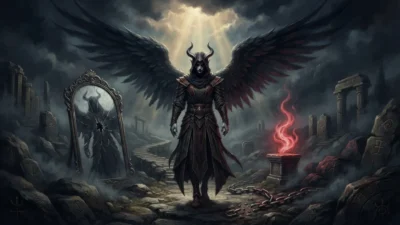
The Devil in Visual Art
Artists have represented the devil using:
- Horns
- Fire
- Red clothing
- Animal features
- Shadows
- Serpents
- Wings
- Weapons
- Dark landscapes
- Flames
These visual elements communicate danger, temptation, power, corruption, and otherness.
Dream Meaning of Devil Symbolism
Dreams involving the devil can be emotionally intense, but they do not automatically indicate supernatural activity.
Common Devil Dream Symbols
| Dream Symbol | Possible Meaning |
|---|---|
| Devil chasing you | Fear, avoidance, unresolved conflict |
| Devil offering a gift | Temptation or difficult choice |
| Talking to the devil | Inner conflict or confronting an uncomfortable issue |
| Fighting the devil | Resistance, courage, personal struggle |
| Defeating the devil | Overcoming fear or destructive behavior |
| Becoming the devil | Concerns about identity, guilt, or behavior |
| Devil in a familiar place | Conflict connected with everyday life |
| Silent devil | Unspoken fear or hidden pressure |
Dream interpretation is personal. The emotions you experienced and the events happening in your waking life are important when considering what the dream may represent.
Modern Meaning of Devil Symbolism
Modern culture often uses devil imagery outside religious contexts.
The devil can represent rebellion, humor, danger, confidence, temptation, or nonconformity.
The “Devil” as a Rebel
In popular culture, a devil may symbolize someone who refuses to follow the rules.
This can make the image appealing in fashion, music, entertainment, and fictional storytelling.
The meaning may be playful rather than genuinely religious.
“Playing Devil’s Advocate”
The expression devil’s advocate refers to someone who argues an opposing position in order to test an idea or strengthen an argument.
Here, the devil has a symbolic role rather than a literal one.
The phrase demonstrates how devil imagery can become part of everyday language.
Devil Symbolism in Fashion and Pop Culture
Devil horns, tails, flames, and red imagery frequently appear in costumes, music, films, games, and graphic design.
In these settings, the symbols may represent confidence, rebellion, humor, danger, sexuality, or theatricality.
The Devil as a Psychological Metaphor
Modern storytelling often uses the devil to represent a person’s shadow side.
This can include desires or impulses that conflict with their values.
The devil therefore becomes a symbolic character representing the question:
What part of yourself are you unwilling to acknowledge?
Devil Symbolism and Personal Growth
Although the devil is usually associated with negative qualities, its symbolism can encourage self-reflection.
Temptation can reveal what a person values. Fear can reveal what needs attention. Conflict can reveal where change may be necessary.
A symbolic growth process might look like:
Temptation → Choice → Consequence → Reflection → Growth
The lesson is not that darkness should be ignored. Instead, understanding difficult emotions and impulses can help a person make wiser choices.
Devil Symbolism at a Glance
| Symbolic Meaning | What It Represents |
|---|---|
| Temptation | Desire competing with values |
| Evil | Harmful or destructive forces |
| Deception | Lies, manipulation, false promises |
| Rebellion | Resistance to authority |
| Pride | Excessive ambition or arrogance |
| Chaos | Disorder and disruption |
| Fear | Threat and uncertainty |
| Forbidden knowledge | Curiosity beyond boundaries |
| Moral conflict | Struggle between right and wrong |
| Consequences | Results of harmful choices |
| Shadow self | Hidden or rejected impulses |
| Power | Desire for control or influence |
Common Symbols Associated With the Devil
Serpent
The serpent is strongly associated with temptation in Christian interpretations of the Garden of Eden, although the biblical text itself does not simply identify the serpent with Satan.
Symbolically, serpents can represent temptation, danger, transformation, wisdom, or hidden knowledge depending on the culture.
Fire
Fire can represent destruction, punishment, passion, danger, or transformation.
Its meaning depends heavily on context.
Red
Red is commonly used in modern devil imagery to suggest danger, fire, anger, passion, and intensity.
Horns
Horns have become a visual shorthand for the devil in Western popular culture.
They communicate wildness, danger, otherness, and supernatural power.
Shadow
A shadow can represent hidden fears, unwanted impulses, guilt, or aspects of the self that a person does not want to confront.
Frequently Asked Questions About Devil Symbolism
What does devil symbolism represent?
Devil symbolism commonly represents temptation, evil, deception, rebellion, pride, moral conflict, fear, and destructive desire. In literature, it can also symbolize freedom or resistance to authority.
What is the spiritual meaning of the devil?
Spiritually, the devil often symbolizes temptation, moral testing, deception, opposition to divine goodness, or separation from spiritual values. Interpretations differ between religious traditions.
What does the devil symbolize in dreams?
A devil in a dream may represent temptation, fear, guilt, inner conflict, or a difficult decision. The dreamer’s emotions and personal circumstances are important for understanding the symbol.
What do devil horns symbolize?
Devil horns are a cultural symbol associated with danger, wildness, rebellion, supernatural power, and the devil. Their familiar appearance developed through centuries of European art and popular culture.
Why is the devil associated with temptation?
The devil is frequently portrayed as a tempter who offers something desirable in exchange for a harmful or morally questionable choice. This makes the figure a powerful symbol of the conflict between immediate desire and long-term consequences.
Conclusion
Devil symbolism is much more complex than a simple representation of evil. Across religion, history, literature, art, dreams, and modern culture, the devil can symbolize temptation, deception, rebellion, pride, fear, moral conflict, forbidden desire, and the darker aspects of human experience.
Its most enduring lesson may be found in the idea of choice. The devil often represents the temptation placed before us, while our response reveals our values, character, and willingness to face consequences.
Ultimately, devil symbolism encourages us to examine not only what we fear in the darkness, but also the choices we make when faced with it.

Miles Arthur is a passionate content writer at Symblosim.com, specializing in symbol meanings, cultural symbolism, spiritual interpretations, and historical signs. He creates informative articles that help readers understand the deeper significance of symbols.