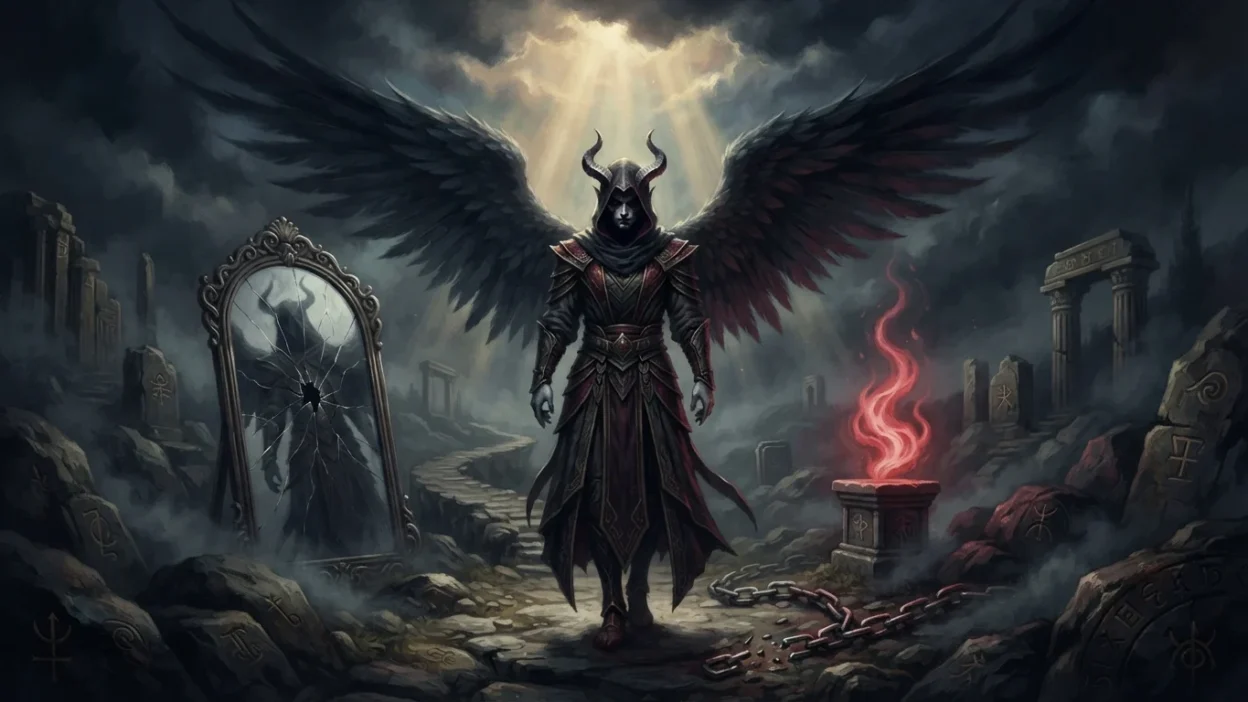
Demon symbolism has appeared in religious traditions, mythology, folklore, literature, art, dreams, and popular culture for thousands of years. Demons are often associated with fear, temptation, chaos, danger, possession, or forces that challenge human control.
However, the meaning of a demon is not always simply “evil.” Across different cultures, demon-like beings can represent illness, natural disasters, forbidden desires, social fears, moral conflict, protection, or unexplained events.
Understanding demon symbolism requires looking at the cultural and historical setting in which the image appears. A demon in religious writing may represent spiritual opposition, while a demon in a modern novel may symbolize trauma, anger, addiction, or an internal struggle.
Demon Symbolism Meaning (Clear Definition)
Demon symbolism refers to the use of demons or demon-like beings to represent fear, temptation, chaos, evil, inner conflict, destructive forces, or the unknown.
The word “demon” has different meanings across cultures. Not every supernatural being described as a demon is considered purely evil, and some traditions contain complex categories of spirits.
Common meanings associated with demon symbolism include:
- Fear and danger
- Temptation
- Evil
- Chaos
- Destructive behavior
- Inner conflict
- Forbidden desire
- Spiritual opposition
- The unknown
- Illness or misfortune
- Rebellion
- Hidden fears
- Transformation
A demon may therefore represent something external, such as a supernatural threat, or something internal, such as guilt, anger, fear, or an unwanted part of the self.
Demon Symbolism vs. Devil Symbolism
Although the words are sometimes used interchangeably in everyday language, demon symbolism and devil symbolism are not always the same.
A devil is often presented as a central embodiment of evil or an adversary of divine authority. A demon can refer more broadly to a supernatural being or spirit, especially in folklore and religious traditions.
The distinction varies significantly between cultures and historical periods.
What Does Demon Symbolism Represent?
Demon symbolism can represent many forms of danger, conflict, and uncertainty.
Fear
One of the strongest meanings of demons is fear.
A demon gives a visible form to something frightening or difficult to understand. This may include death, illness, violence, uncertainty, or the fear of losing control.
Temptation
Demons are sometimes portrayed as beings that encourage people to make destructive choices.
This makes them symbols of temptation, especially when someone is struggling between immediate desire and long-term consequences.
Inner Conflict
Modern stories frequently use demons as metaphors for internal struggles.
A person’s “inner demon” may symbolize:
- Anger
- Addiction
- Guilt
- Jealousy
- Trauma
- Shame
- Fear
- Obsessive thoughts
- Destructive habits
In this interpretation, defeating a demon can symbolize overcoming a personal challenge.
Chaos
Demons can also symbolize disorder.
Where a peaceful spiritual figure may represent harmony and stability, a demon may represent disruption, unpredictability, or forces that seem impossible to control.
The Unknown
People have historically used supernatural explanations for things they could not understand.
Demon imagery can therefore symbolize the mysterious or unknown aspects of existence.
Rebellion
In some literary and cultural interpretations, demons represent resistance to authority.
They may challenge religious rules, social expectations, or established systems.
This interpretation can make demons complicated figures rather than simple villains.
Spiritual Meaning of Demon Symbolism
The spiritual meaning of demons depends strongly on the religious tradition involved.
In some belief systems, demons are viewed as harmful supernatural beings. In others, demon-like beings occupy more complicated roles, and the term itself may not carry the same meaning as it does in modern Western culture.
Spiritually, demon symbolism may represent:
- Spiritual temptation
- Moral testing
- Fear
- Negative influence
- Separation from sacred values
- Unresolved inner conflict
- Spiritual struggle
- The consequences of harmful choices
- The unknown
Demons as Spiritual Challenges
A demon can symbolically represent a challenge that tests a person’s beliefs and character.
Stories about confronting demons often focus on courage, faith, discipline, and the ability to resist destructive influences.
Demons and the Shadow Self
In psychological and literary interpretations, the demon can represent the shadow self—qualities a person fears, rejects, or refuses to acknowledge.
This does not mean that every difficult emotion is evil. Rather, the demon becomes a metaphor for parts of the personality that require awareness and understanding.
Confronting the Demon
The phrase “facing your demons” has become a powerful metaphor.
It usually means confronting painful memories, unhealthy habits, fears, guilt, or unresolved personal problems.
The symbolic journey is often:
Fear → Confrontation → Understanding → Healing
Biblical / Religious Meaning of Demon Symbolism
Demon beliefs differ widely among religions, and the modern image of demons has developed from many different historical sources.
Demons in Christianity
Christian traditions generally understand demons as evil spiritual beings opposed to God.
The New Testament contains accounts of people described as being affected or possessed by unclean spirits. Christian theology commonly connects demons with spiritual evil and opposition to divine purposes.
However, biblical descriptions are more varied than the standardized demon imagery found in modern films and fantasy.
Demons in Judaism
Jewish traditions contain various ideas about harmful or supernatural beings, although these concepts developed differently across biblical, rabbinic, and later folklore.
The Hebrew Bible does not present a single simple demonology comparable to modern fantasy.
Later Jewish folklore includes beings such as shedim, which have been interpreted in different ways throughout Jewish history.
Demons in Islam
Islam has a well-developed concept of the unseen world.
The jinn are a distinct category of creation in Islamic belief and should not simply be equated with demons. Some jinn may be described as good, while others can be harmful.
The concept of shaytan is associated with beings or influences that tempt people away from righteousness.
Demons in Other Traditions
Many cultures have stories about supernatural beings that can harm, deceive, protect, punish, or teach humans.
The categories used to describe these beings vary significantly. A creature labeled a “demon” in one modern translation may have had a very different role in its original cultural setting.
Demon Symbolism in History and Culture
Demon-like figures have existed across many civilizations.
Not all of these beings were viewed in exactly the same way. Some could be dangerous, while protective rituals and figures were also used against harmful supernatural forces.
This demonstrates an important point: supernatural beings do not always fit neatly into the categories of “good” and “evil.”
Ancient Greece
Greek mythology included various supernatural beings that could be dangerous, frightening, or morally complex.
The Greek word daimon originally had a broader meaning than the modern English word “demon.” It could refer to a divine or supernatural power or being without automatically meaning something evil.
Over time, later religious and linguistic developments contributed to the negative meaning associated with “demon.”
Medieval Europe
During the medieval period, Christian demonology became increasingly developed.
Artists and writers portrayed demons with animal-like features, claws, wings, horns, tails, and frightening faces.
These visual characteristics helped communicate spiritual danger and moral corruption.
Demons in Folklore
Folk traditions around the world contain stories about beings that cause nightmares, illness, misfortune, or supernatural disturbances.
These stories often reflect the fears and values of the societies that created them.
Demon Symbolism in Literature and Art
Demon symbolism is especially powerful in literature because demons can represent both external threats and internal struggles.
Demons as Villains
The most straightforward use of a demon is as an antagonist.
A demon may threaten a character’s safety, family, faith, or community.
This creates a clear conflict between the protagonist and an embodiment of danger.
Demons as Inner Struggles
More complex stories use demons metaphorically.
A character may battle a demon that represents:
- Grief
- Addiction
- Anger
- Trauma
- Guilt
- Ambition
- Jealousy
- Fear
The supernatural conflict then becomes a representation of psychological or emotional conflict.
Demons and Temptation in Literature
A demon may offer a character something they desperately want.
This creates a moral test.
The character’s response reveals their priorities and values, making the demon a symbolic tool for exploring human weakness.
Demon Imagery in Art
Artists have used visual features such as:
- Horns
- Claws
- Fangs
- Wings
- Fire
- Shadows
- Red or black coloring
- Distorted faces
- Animal features
These elements create associations with danger, otherness, chaos, and fear.
However, demon imagery can also be satirical, humorous, theatrical, or symbolic rather than genuinely frightening.
Dream Meaning of Demon Symbolism
Dreams involving demons can be intense, but they do not automatically indicate supernatural activity.
Common Demon Dream Symbols
| Dream Symbol | Possible Meaning |
|---|---|
| Demon chasing you | Avoidance, fear, unresolved problems |
| Demon attacking you | Vulnerability, stress, emotional pressure |
| Fighting a demon | Resistance and personal courage |
| Defeating a demon | Overcoming a challenge |
| Talking to a demon | Inner conflict or difficult decision |
| Demon offering something | Temptation or questionable opportunity |
| Familiar person as a demon | Relationship conflict or mistrust |
| Demon disappearing | Release, acceptance, or emotional change |
Dream interpretation is personal. The emotions experienced during the dream and events in waking life are often more useful than relying on a fixed symbolic dictionary.
Modern Meaning of Demon Symbolism
Today, demons are widely used as metaphors in everyday language, entertainment, psychology-inspired storytelling, and popular culture.
“Fighting My Demons”
The expression fighting my demons usually means dealing with difficult personal experiences or emotional struggles.
It may refer to grief, addiction, regret, anxiety, anger, trauma, or unhealthy behavior.
The phrase has transformed demon symbolism into a common metaphor for personal growth.
Demon as a Symbol of Addiction
Stories sometimes portray addiction as a demon that constantly returns.
This imagery emphasizes the feeling of being trapped in a repeating cycle and the difficulty of breaking free.
Demon as Rebellion
In modern entertainment, demons can sometimes symbolize individuality, rebellion, or resistance to authority.
This is particularly common in fantasy, music, fashion, gaming, and graphic design.
Demon Symbolism in Horror
Horror films and novels often use demons to explore fear of losing control.
Possession stories are especially powerful because they transform an internal question—“What if I am no longer in control of myself?”—into a supernatural scenario.
Demon Symbolism and Personal Growth
Although demons are usually associated with negative ideas, their symbolism can have a constructive interpretation.
Facing a demon can represent confronting something difficult rather than avoiding it.
A personal-growth interpretation might look like:
Fear → Awareness → Confrontation → Understanding → Transformation
This is why the phrase “defeating your demons” can feel inspirational.
The demon becomes a symbol of an obstacle that once seemed overwhelming but can eventually be understood, managed, or overcome.
The Demon as a Teacher
In some stories, confronting a frightening figure reveals an important truth about the protagonist.
The demon may expose:
- Hidden fears
- Unhealthy desires
- Unresolved guilt
- Personal weaknesses
- Forgotten memories
- Unrecognized strengths
The symbolic lesson is that difficult experiences can sometimes reveal parts of ourselves that need attention.
Demon Symbolism at a Glance
| Symbolic Meaning | What It Represents |
|---|---|
| Fear | Threat, anxiety, uncertainty |
| Temptation | Desire and moral choice |
| Evil | Destructive or harmful forces |
| Chaos | Disorder and unpredictability |
| Inner conflict | Struggle within the self |
| Guilt | Regret and unresolved responsibility |
| Rebellion | Resistance to authority |
| Addiction | Repeating destructive patterns |
| Shadow self | Rejected or hidden qualities |
| Unknown | Things humans cannot explain |
| Transformation | Growth through confrontation |
| Protection | The need to defend against danger |
Common Symbols Associated With Demons
Fire
Fire often represents destruction, danger, punishment, passion, and transformation.
Its meaning changes according to the story and culture.
Horns
Horns have become a familiar visual symbol of demons in Western art and popular culture.
They can suggest wildness, danger, animal nature, and supernatural power.
Shadows
Shadows are frequently connected with demons because they symbolize hidden fears, uncertainty, secrecy, and the darker side of experience.
Serpents
Serpents can represent temptation, danger, transformation, hidden knowledge, or deception. Their association with demons varies considerably across traditions.
Black Color
Black is often used in demon imagery to create associations with mystery, darkness, death, secrecy, and the unknown.
However, black itself is not inherently a symbol of evil. Its meaning changes across cultures.
Chains
Chains may symbolize imprisonment, addiction, guilt, control, or the feeling of being trapped.
In a story about overcoming demons, broken chains can represent freedom and recovery.
Frequently Asked Questions About Demon Symbolism
What does demon symbolism represent?
Demon symbolism commonly represents fear, temptation, evil, chaos, deception, inner conflict, guilt, rebellion, and the unknown. In modern storytelling, it can also represent personal struggles.
What is the spiritual meaning of a demon?
Spiritually, demons may symbolize temptation, spiritual opposition, moral testing, harmful influences, or separation from sacred values. Interpretations vary significantly among religions.
What does a demon symbolize in dreams?
A demon in a dream may represent fear, guilt, stress, temptation, unresolved conflict, or something that feels difficult to control. The dreamer’s emotions and personal circumstances provide important context.
What does fighting a demon symbolize?
Fighting a demon often symbolizes confronting a personal challenge, fear, harmful habit, or internal conflict. It can represent courage and the desire for change.
What does “fighting your demons” mean?
“Fighting your demons” is a metaphor for dealing with difficult experiences, painful emotions, unhealthy habits, or unresolved personal problems. It does not necessarily refer to literal supernatural beings.
Conclusion
Demon symbolism represents some of humanity’s deepest fears and struggles. Across religion, history, folklore, literature, dreams, art, and modern culture, demons can symbolize temptation, danger, chaos, guilt, rebellion, spiritual conflict, and the hidden parts of human nature.
Yet the demon is not always simply a symbol of darkness. In many modern interpretations, confronting a demon represents the courage to face what has been avoided.
Ultimately, demon symbolism can remind us that understanding our fears is often the first step toward overcoming them. What initially appears as a terrifying force may, symbolically, reveal an opportunity for awareness, growth, and transformation.

Thomas Luke is a dedicated symbolism writer at Symblosim.com, exploring symbol meanings, cultural traditions, spiritual symbolism, and historical interpretations. He creates insightful content that helps readers uncover the stories and significance behind symbols.