Angel symbolism has inspired people for centuries because angels are commonly associated with protection, guidance, hope, divine messages, and spiritual connection. They appear in religious traditions, myths, literature, artwork, dreams, and modern culture.
An angel is often imagined as a messenger between the human and divine realms. Because of this role, angel symbolism can represent communication, reassurance, faith, transformation, and the feeling that something greater is watching over us.
The meaning of an angel can change depending on its appearance, behavior, cultural setting, or personal significance. Understanding these different interpretations can make angel imagery more meaningful in spiritual traditions, stories, dreams, and everyday life.
Angel Symbolism Meaning (Clear Definition)
Angel symbolism refers to the use of angels as representations of divine guidance, protection, hope, purity, spiritual messages, and connection with a higher power.
Angels are usually depicted as supernatural or spiritual beings who exist between the human and divine worlds. Their symbolic role often involves carrying messages, protecting people, offering guidance, or witnessing important events.
Common meanings associated with angel symbolism include:
- Protection
- Divine guidance
- Hope
- Faith
- Purity
- Love
- Peace
- Spiritual messages
- Wisdom
- Transformation
- Comfort
- Divine presence
The exact meaning depends on the tradition. An angel with open wings may emphasize freedom or protection, while an angel carrying a message may symbolize communication or divine guidance.
Common Angel Symbols
Certain features are repeatedly associated with angels:
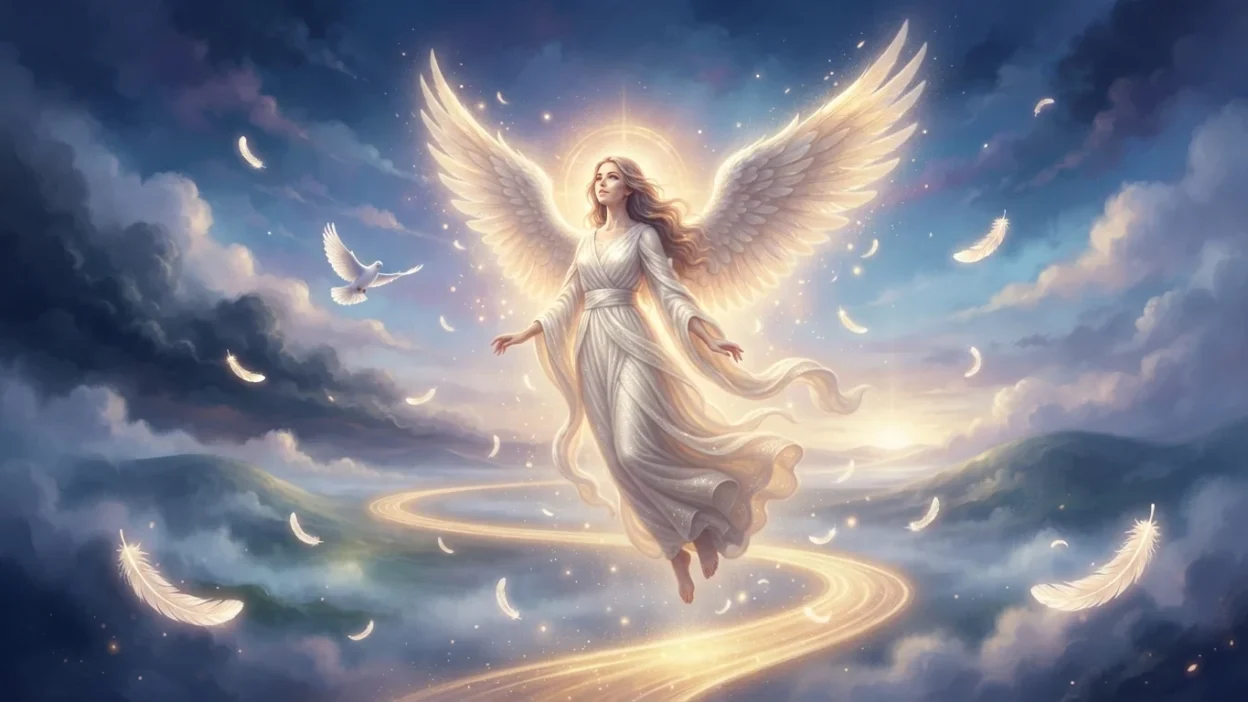
- Wings: Freedom, protection, transcendence, and movement between worlds.
- Light: Divine presence, truth, hope, and spiritual awareness.
- Halo: Holiness, sacredness, and spiritual purity.
- White clothing: Purity, peace, and goodness.
- Trumpet: Announcement, revelation, or an important message.
- Sword: Protection, justice, and spiritual authority.
What Does Angel Symbolism Represent?
Angel symbolism can represent several powerful ideas connected with spirituality and human experience.
Protection
One of the most familiar meanings of an angel is protection.
Guardian angels are commonly imagined as spiritual protectors who watch over individuals during difficult or dangerous moments.
Because of this association, angel imagery is often used on memorial objects, jewelry, artwork, and personal keepsakes.
Guidance
Angels can symbolize guidance when a person feels uncertain about a decision or direction.
In stories and religious traditions, an angel may appear with information that helps someone understand what to do next.
Symbolically, this can represent intuition, wisdom, faith, or the search for direction.
Hope
Angels are often associated with hope because they appear during moments of uncertainty or difficulty.
An angel appearing in darkness can symbolize the possibility that light and support still exist even when circumstances feel overwhelming.
Divine Messages
The word “angel” comes from a tradition strongly connected with the idea of a messenger.
For this reason, angel symbolism can represent communication between the earthly and spiritual realms.
An angel carrying a message may symbolize revelation, truth, warning, or important knowledge.
Purity and Goodness
Angels are frequently depicted as beautiful, radiant, and peaceful beings.
This visual tradition has made them symbols of purity, innocence, goodness, compassion, and moral beauty.
Comfort
Angel imagery can also provide emotional comfort.
In times of grief, people may see angels as symbols of peace, spiritual companionship, or hope beyond loss.
Spiritual Meaning of Angel Symbolism
The spiritual meaning of angels is closely connected with divine presence, guidance, protection, and transcendence.
For many believers, angels represent beings that connect the human world with a higher spiritual reality.
Angel symbolism may therefore suggest:
- Divine protection
- Spiritual guidance
- Faith
- Inner peace
- Higher purpose
- Hope
- Divine communication
- Spiritual awakening
- Compassion
- Reassurance
Guardian Angel Symbolism
The guardian angel is one of the most recognizable angelic ideas.
Symbolically, a guardian angel represents the belief that a person is not completely alone. It can express protection, care, guidance, and spiritual companionship.
Even outside formal religious belief, guardian angel imagery can represent the feeling of having someone or something looking after you.
Angels and Spiritual Awakening
An angel may symbolize a moment of greater awareness.
Light, wings, heavenly music, or a descending angel can represent movement from confusion toward understanding.
In this sense, the angel becomes a symbol of awakening and recognition.
Angel Wings and Transcendence
Wings are particularly important in angel symbolism.
They suggest movement beyond ordinary physical limitations and can represent freedom, spiritual elevation, protection, and the connection between heaven and earth.
Biblical / Religious Meaning of Angel Symbolism
Angels play an important role in several religious traditions, especially Judaism, Christianity, and Islam.
However, the understanding of angels differs across these traditions. They should not be treated as identical concepts in every religion.
Angels in Christianity
In Christianity, angels are spiritual beings who serve God and appear in numerous biblical narratives.
They may deliver messages, protect, worship God, announce important events, or participate in divine judgment.
Some well-known biblical angels include Gabriel and Michael.
Gabriel is particularly associated with delivering important divine messages, while Michael is traditionally associated with spiritual conflict and protection.
Angels in Judaism
Angelic beings appear throughout Jewish scripture and tradition.
The Hebrew Bible includes figures and beings that act as messengers or servants of God. Jewish interpretations of angels vary, and later traditions developed additional ideas about angelic beings and their roles.
The Hebrew concept of an angel is closely connected with the idea of a messenger.
Angels in Islam
Angels, known as mala’ika, hold an important place in Islamic belief.
They are understood as beings created by God who carry out divine commands. Islamic tradition includes well-known angels such as Jibril (Gabriel), Mikail (Michael), and Israfil.
Angels are associated with revelation, recording human deeds, carrying out divine commands, and other spiritual functions.
Angels in Other Traditions
Ideas resembling divine or supernatural messengers appear in many cultures.
However, not every winged or supernatural being from mythology should automatically be called an angel. Different traditions have their own concepts, names, functions, and meanings.
This diversity makes angel symbolism a broad subject rather than a single universal belief.
Angel Symbolism in History and Culture
Angelic imagery has developed over thousands of years.
Although modern Western images often show angels as winged human figures, the history of angelic representation is more complex.
Ancient Influences
Ancient cultures included supernatural beings associated with gods, protection, divine authority, and communication.
Some artistic traditions influenced later representations of angels, particularly the use of wings to communicate supernatural movement or heavenly status.
Medieval Angel Symbolism
During the medieval period in Europe, angels became prominent in Christian art.
Artists frequently depicted angels surrounding Christ, appearing beside saints, announcing divine events, or guiding souls.
Angels became visual symbols of heavenly order, holiness, protection, and divine communication.
Renaissance Angel Imagery
Renaissance artists developed increasingly detailed representations of angels.
They appeared in paintings, sculptures, architecture, and religious scenes.
The use of light, beautiful human forms, wings, musical instruments, and graceful movement emphasized their connection with the divine.
Angels Across Popular Culture
Modern culture has expanded angel imagery beyond traditional religious settings.
Angels now appear in:
- Movies
- Television
- Fantasy stories
- Tattoos
- Jewelry
- Memorial art
- Music
- Fashion
- Children’s stories
- Video games
Their meanings can range from sacred protection to romance, innocence, fantasy, or personal remembrance.
Angel Symbolism in Literature and Art
Angels have played an important role in literature because they can represent forces beyond ordinary human experience.
A writer may use an angel as a literal supernatural character or as a metaphor for morality, temptation, protection, or transformation.
Angels as Messengers
In literature, an angel may bring information that changes a character’s life.
This makes the angel a symbolic bridge between ignorance and knowledge.
The message may reveal a truth, provide a warning, or announce an important future event.
Angels as Protectors
An angel can also serve as a guardian figure.
A character protected by an angel may symbolize innocence, vulnerability, hope, or divine favor.
Angels and Morality
Angels are sometimes contrasted with demons or other supernatural beings.
This creates symbolic oppositions such as:
Good vs. evil
Light vs. darkness
Protection vs. danger
Purity vs. corruption
However, literature often complicates these simple oppositions by portraying supernatural beings with ambiguous motives.
Angel Symbolism in Visual Art
Common angelic images in art include:
- Wings
- Halos
- Golden light
- White robes
- Harps
- Trumpets
- Swords
- Clouds
- Stars
- Radiant skies
Each element can add another layer of symbolic meaning.
Dream Meaning of Angel Symbolism
Dreams involving angels are often interpreted as symbols of comfort, guidance, hope, protection, or spiritual reflection.
There is no single universal meaning for an angel dream. Personal beliefs, emotions, and circumstances strongly influence interpretation.
A peaceful angel may represent comfort or reassurance.
A guardian angel may symbolize a desire for protection or support.
A speaking angel may represent an important message, insight, or decision that the dreamer needs to consider.
A bright angel may symbolize hope, clarity, or spiritual awareness.
Common Angel Dream Symbols
| Angel Dream Symbol | Possible Meaning |
|---|---|
| Guardian angel | Protection and reassurance |
| White angel | Purity, peace, innocence |
| Glowing angel | Hope, awareness, spiritual inspiration |
| Angel with wings | Freedom, protection, transcendence |
| Speaking angel | Guidance or important information |
| Angel in the sky | Higher purpose or spiritual reflection |
| Fallen angel | Conflict, temptation, loss, or transformation |
| Angel protecting you | Security, support, emotional comfort |
Dream interpretation should be personal rather than absolute. The emotions you experienced in the dream can be more important than the symbol itself.
Modern Meaning of Angel Symbolism
Today, angel symbolism has both religious and secular meanings.
People may use angel imagery because of their faith, but others may choose it to represent love, remembrance, protection, or personal transformation.
Angel Symbolism and Grief
Angels are often used in memorial jewelry, artwork, and tattoos.
In these contexts, an angel can symbolize a loved one who has died, continuing love, remembrance, peace, or hope.
Angel Symbolism in Jewelry
Angel pendants, necklaces, bracelets, and charms are commonly worn as symbolic objects.
They may represent:
- Protection
- Faith
- A loved one
- Guidance
- Personal strength
- Hope
The meaning is often highly personal.
Angel Tattoos
An angel tattoo may represent faith, protection, remembrance, freedom, or overcoming a difficult period.
Adding elements such as wings, roses, light, names, dates, or halos can create additional meanings.
Angel Numbers
Modern spiritual culture also uses the phrase angel numbers for repeating numerical patterns such as 111, 222, or 333.
These interpretations are part of contemporary numerological and spiritual practices rather than a universal religious teaching. Their meaning depends on the belief system of the person using them.
Angel Symbolism and Personal Growth
Angel symbolism can also represent personal transformation.
The angel’s movement between heaven and earth creates a useful metaphor for growth: remaining connected to everyday life while reaching toward higher values.
An angel may therefore symbolize the journey from:
Fear → Courage
Confusion → Clarity
Isolation → Connection
Pain → Healing
Uncertainty → Hope
This makes angel imagery meaningful even outside formal religious settings.
Angel Symbolism at a Glance
| Symbolic Meaning | What It Represents |
|---|---|
| Protection | Safety, care, spiritual guardianship |
| Guidance | Direction, wisdom, intuition |
| Hope | Encouragement during difficult times |
| Purity | Innocence, goodness, moral beauty |
| Faith | Trust in a higher power |
| Messages | Divine communication and revelation |
| Love | Compassion and spiritual connection |
| Freedom | Wings, transcendence, release |
| Peace | Comfort, harmony, reassurance |
| Transformation | Growth and spiritual awakening |
| Remembrance | Connection with someone who has died |
| Justice | Moral authority and divine judgment |
Common Symbols Associated With Angels
Wings
Wings represent freedom, transcendence, protection, and the ability to move between earthly and heavenly realms.
Halo
A halo traditionally symbolizes holiness, sacredness, spiritual illumination, and divine favor.
Light
Radiant light often represents truth, hope, goodness, divine presence, and spiritual awareness.
Dove
The dove is strongly associated with peace and, in Christian symbolism, the Holy Spirit. It may also reinforce themes of purity and gentleness.
Sword
A sword can symbolize protection, justice, authority, and spiritual warfare.
Trumpet
A trumpet can represent announcement, revelation, judgment, or an important divine event.
Frequently Asked Questions About Angel Symbolism
What does angel symbolism represent?
Angel symbolism commonly represents protection, divine guidance, hope, purity, faith, spiritual messages, peace, and connection with a higher power.
What is the spiritual meaning of an angel?
Spiritually, an angel may symbolize divine protection, guidance, reassurance, spiritual awakening, or communication with a higher power. The interpretation depends on the person’s religious or spiritual beliefs.
What does an angel symbolize in dreams?
An angel in a dream may symbolize protection, comfort, guidance, hope, or an important personal insight. The dreamer’s emotions and circumstances are important when interpreting the image.
What do angel wings symbolize?
Angel wings commonly symbolize freedom, protection, transcendence, spiritual elevation, and the connection between the earthly and divine realms.
What does a guardian angel symbolize?
A guardian angel symbolizes protection, care, guidance, and reassurance. It can also represent the feeling that a person is spiritually supported during difficult experiences.
Conclusion
Angel symbolism continues to be powerful because it gives visual form to ideas such as protection, hope, guidance, faith, love, and divine connection. Across religious traditions, history, art, literature, dreams, and modern culture, angels often occupy the space between the human and the sacred.
Whether an angel is understood as a religious being, a symbolic protector, or a personal reminder of someone loved, its central message is often one of hope and connection. Angel imagery reminds us that even during uncertain moments, people continue to search for guidance, meaning, and light.