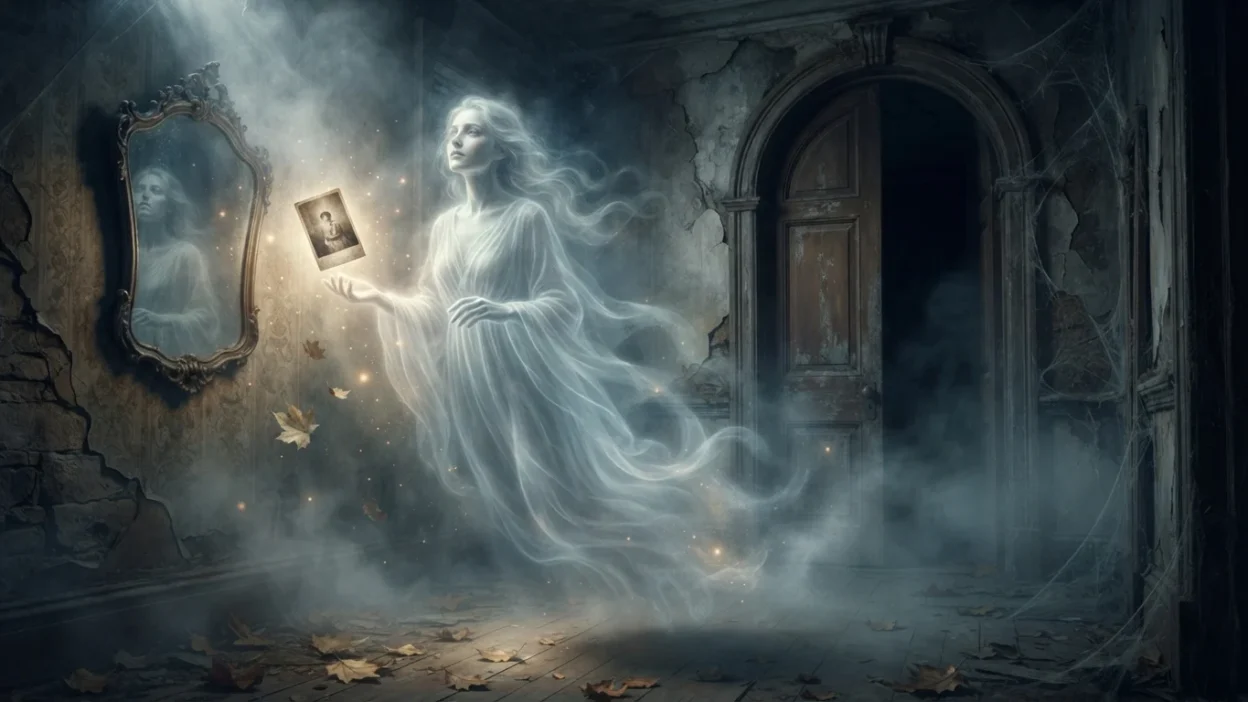
Ghost symbolism has fascinated people for centuries because ghosts represent the mysterious boundary between life and death. In stories, religions, dreams, and art, a ghost can symbolize memory, grief, fear, unfinished business, change, or the unknown.
A ghost is often imagined as the presence of someone who has died, but its symbolic meaning can go much deeper. Sometimes a ghost represents the past that refuses to disappear. At other times, it reflects guilt, regret, hidden emotions, or something a person feels unable to leave behind.
Understanding ghost symbolism helps explain why ghost stories remain powerful across cultures. Whether viewed as a supernatural being or a metaphor for human experience, the ghost often reminds us that the past can continue to influence the present.
Ghost Symbolism Meaning (Clear Definition)
Ghost symbolism refers to the use of a ghost or spirit of the dead to represent memory, mortality, grief, fear, unfinished business, the past, or the unknown.
The exact meaning depends on the context. A friendly ghost may symbolize comfort or remembrance, while a frightening ghost may represent fear, guilt, trauma, or unresolved conflict.
Common meanings associated with ghost symbolism include:
- Death and mortality
- Memory and remembrance
- Grief and loss
- The past
- Unfinished business
- Fear of the unknown
- Guilt and regret
- Hidden emotions
- Transformation
- Spiritual mystery
- Warning or guidance
- The persistence of memory
Ghosts are especially powerful symbols because they exist between categories. They are neither fully alive nor fully absent, making them natural symbols of uncertainty and transition.
Ghost as a Symbol of the Past
One of the strongest meanings of a ghost is the past returning to the present.
A forgotten relationship, painful memory, old mistake, or historical event can metaphorically become a “ghost.”
In this sense, the ghost does not need to be supernatural. It represents something that still has emotional power.
What Does Ghost Symbolism Represent?
Ghost symbolism can represent both external fears and internal experiences. Its meaning often depends on what the ghost is doing and how the person encountering it feels.
Death and Mortality
The most obvious meaning of a ghost is the connection between life and death.
Ghosts remind people that physical life is temporary. For this reason, ghost imagery frequently appears in stories about mortality, aging, funerals, and the afterlife.
Memory and Remembrance
A ghost can represent someone who is physically gone but remains emotionally present.
A deceased loved one may be described metaphorically as a “ghost” in someone’s life because memories of that person continue to influence their emotions.
Grief and Loss
Ghost symbolism can express the complicated nature of grief.
After losing someone, memories may feel unusually vivid. A person may continue to think about conversations, experiences, or moments shared with the deceased.
In literature, a ghost can therefore symbolize grief that has not yet been resolved.
Unfinished Business
A ghost that cannot move on is often interpreted as a symbol of unfinished business.
This may represent:
- Unspoken words
- Unresolved conflict
- Unfulfilled promises
- Regret
- Guilt
- An incomplete journey
The ghost remains because something has not reached an emotional or symbolic conclusion.
Fear of the Unknown
Ghosts also symbolize what people cannot fully understand.
Questions about death, consciousness, and what happens after life naturally create uncertainty. Ghost stories turn these abstract fears into visible characters.
Guilt and Regret
In psychological and literary symbolism, ghosts may represent guilt.
Someone haunted by their past may be described as “followed by ghosts.” The ghost becomes a representation of actions that cannot be undone.
Change and Transition
Although ghosts are associated with death, they can also represent transformation.
The ghost exists in an in-between state. This makes it a useful symbol for periods when someone is leaving one part of life behind but has not yet fully entered another.
Spiritual Meaning of Ghost Symbolism
The spiritual interpretation of ghosts varies greatly between cultures and religious traditions.
Some people understand ghosts as spirits of deceased people. Others view ghost stories as symbolic expressions of memory, grief, or psychological experiences.
Spiritually, ghost symbolism may represent:
- The connection between life and death
- The afterlife
- Unresolved spiritual matters
- Messages from the past
- Ancestral memory
- Spiritual protection
- Warning
- Transition
- The mystery of existence
Ghosts and the Afterlife
In traditions that believe consciousness continues after death, ghosts may symbolize the possibility that some aspect of a person survives physical death.
The ghost therefore becomes a symbol of continuity between two worlds.
Ghosts as Messengers
In folklore and storytelling, ghosts sometimes appear to deliver warnings or reveal hidden information.
This gives them a symbolic role as messengers between the known and unknown.
A ghost may reveal a secret, warn a character about danger, or encourage someone to correct a past mistake.
Ghosts and Spiritual Unrest
A restless ghost is often interpreted as a symbol of spiritual or emotional disturbance.
Its inability to move forward may represent an unresolved relationship, broken promise, injustice, or painful memory.
Biblical / Religious Meaning of Ghost Symbolism
Ghost symbolism in religious traditions is complex because different faiths have different teachings about death, spirits, resurrection, and the afterlife.
In Christianity, the Bible contains references to spirits, apparitions, resurrection, and the Holy Spirit, but these concepts should not automatically be treated as equivalent to the modern idea of a ghost.
Ghosts in Christianity
Christian teachings generally distinguish between the Holy Spirit, angels, demons, the dead, and supernatural manifestations.
Biblical stories sometimes describe unusual spiritual appearances, but Christianity does not present a single simple definition of ghosts.
The Christian symbolism of a ghost may therefore involve questions about mortality, judgment, resurrection, spiritual existence, or the difference between earthly and divine realities.
Ghosts in Judaism
Jewish folklore contains traditions concerning spirits and the dead, including later concepts such as the dybbuk, a possessing spirit found especially in Jewish folklore.
These traditions vary historically and should not be confused with a single official religious doctrine.
Ghosts in Islam
Islamic teachings contain concepts involving the unseen world, including angels and jinn. However, jinn should not simply be described as ghosts because they are understood as a distinct category of creation.
This distinction is important when discussing religious symbolism accurately.
Religious Meaning of the Dead
Across many religious traditions, beliefs about death encourage reflection on morality, the afterlife, remembrance, and the meaning of human existence.
Some traditions viewed restless dead as dangerous, while others emphasized rituals intended to honor ancestors or help the dead reach the next stage of existence.
Burial customs often reflected beliefs about what happened after death.
European Ghost Traditions
European folklore contains numerous stories about haunted houses, restless spirits, wandering dead, and supernatural apparitions.
Ghost stories were often used to explain mysterious events, preserve local legends, or teach moral lessons.
Asian Ghost Traditions
Many Asian cultures have rich traditions involving spirits of the dead.
Some stories describe ghosts as dangerous beings, while others portray them as relatives, protectors, or figures connected with family obligations.
In several traditions, festivals and rituals emphasize remembrance of ancestors and the relationship between the living and the dead.
Ghosts and Cultural Memory
Ghosts can also symbolize historical memory.
A haunted building, battlefield, or abandoned place may be described as “haunted” because its history remains emotionally powerful.
In this sense, ghost symbolism can preserve stories that a society does not want to forget.
Ghost Symbolism in Literature and Art
Ghosts have played a major role in literature because they allow writers to explore invisible emotional and moral forces.
A ghost can reveal secrets, punish wrongdoing, encourage change, or force characters to confront their past.
Ghosts as Symbols of Guilt
One of the most common literary uses of ghosts is to represent guilt.
A character may be “haunted” by a past action even when no literal ghost exists.
The supernatural image gives physical form to an internal emotional burden.
Ghosts as Symbols of Memory
A ghost may also represent memories that refuse to disappear.
This is especially powerful in stories about lost relationships, family history, war, or personal tragedy.
The ghost becomes a reminder that forgetting is not always possible.
Ghosts and Social Criticism
Writers sometimes use ghosts to represent forgotten people or neglected social problems.
A ghost can symbolize victims whose stories have been ignored.
In this way, supernatural fiction can address real issues such as injustice, inequality, violence, and historical trauma.
Ghosts in Visual Art
Artists may represent ghosts through:
- Transparent human figures
- Shadows
- White clothing
- Mist and fog
- Mirrors
- Empty rooms
- Abandoned buildings
- Fading photographs
- Pale light
These images create a sense of absence and presence at the same time.
Dream Meaning of Ghost Symbolism
Dreams about ghosts are common subjects of personal interpretation. They do not have one universal meaning, and the dreamer’s emotions are especially important.
A friendly ghost may represent memory, comfort, acceptance, or a continuing emotional connection.
A frightening ghost may symbolize fear, anxiety, guilt, or something the dreamer does not want to confront.
A ghost of someone who has died may reflect grief, memories, or unresolved feelings rather than a literal supernatural encounter.
Common Ghost Dream Symbols
| Ghost Dream Symbol | Possible Meaning |
|---|---|
| Friendly ghost | Comfort, memory, acceptance |
| Frightening ghost | Fear, anxiety, unresolved concerns |
| Ghost of a loved one | Grief, remembrance, emotional connection |
| Chasing ghost | Avoidance, fear, unresolved past |
| Talking ghost | Reflection, memory, unanswered questions |
| Haunted house | Troubled memories or emotional history |
| Ghost disappearing | Acceptance, closure, letting go |
| Becoming a ghost | Identity change, isolation, feeling unseen |
Dream interpretation is personal. The same ghost image can have very different meanings depending on the dreamer’s life and emotions.
Modern Meaning of Ghost Symbolism
Today, ghost symbolism extends far beyond supernatural stories.
The word “ghost” is often used metaphorically in everyday language.
Ghosting
Ghosting means suddenly ending communication with someone without explanation.
Although the modern slang meaning is different from traditional ghost symbolism, the metaphor is fitting: the person disappears without providing closure.
Feeling Like a Ghost
Someone may describe themselves as feeling like a ghost when they feel invisible, ignored, disconnected, or emotionally distant.
Here, the ghost symbolizes absence rather than supernatural existence.
Ghosts and Digital Memory
Modern technology has created new forms of memory.
Old photographs, deleted messages, inactive social media accounts, and digital profiles can preserve traces of people who are no longer part of our lives.
These digital traces can function like modern “ghosts”—reminders of people or experiences that have disappeared physically but remain accessible.
Ghost as a Symbol of the Past
Modern writers frequently use ghosts metaphorically to describe historical trauma, old relationships, personal regrets, and unresolved experiences.
This makes ghost symbolism relevant even for people who do not believe in supernatural beings.
Ghost Symbolism and Personal Growth
A ghost can represent something that needs to be acknowledged before a person can move forward.
The symbolic journey may look like this:
Memory → Confrontation → Understanding → Acceptance → Release
This is why ghost stories often end with a spirit finding peace.
The deeper message is not always about the ghost itself. It may be about a living person learning to accept the past.
A ghost can therefore symbolize the emotional weight we carry—and the possibility of letting that weight go.
Ghost Symbolism at a Glance
| Symbolic Meaning | What It Represents |
|---|---|
| Death | Mortality and the end of physical life |
| Memory | The persistence of the past |
| Grief | Emotional response to loss |
| Unfinished business | Unresolved problems or relationships |
| Guilt | Regret over past actions |
| Fear | Anxiety about the unknown |
| History | Memories of past events |
| Transition | Movement between stages of life |
| Mystery | What cannot be explained |
| Warning | A lesson or message |
| Isolation | Feeling unseen or disconnected |
| Release | Acceptance and letting go |
Common Symbols Associated With Ghosts
Ghosts are often paired with other symbols that strengthen their meaning.
Mirror
A mirror can symbolize identity, memory, and the boundary between appearance and reality. In ghost stories, it may also represent the fear of seeing something that should not be there.
Fog
Fog represents uncertainty and limited understanding. It is often used with ghosts because both create a sense of mystery and incomplete knowledge.
Shadow
A shadow can represent the hidden or forgotten parts of the self. A ghostly shadow may symbolize memories or emotions that remain just outside conscious attention.
Old Photograph
Photographs preserve moments from the past, making them natural companions to ghost symbolism.
An old photograph can symbolize memory, loss, nostalgia, and the passage of time.
Abandoned House
An abandoned house often represents forgotten history, loneliness, or memories left behind.
In ghost stories, it can become a physical representation of the past refusing to disappear.
Frequently Asked Questions About Ghost Symbolism
What does ghost symbolism represent?
Ghost symbolism commonly represents death, memory, grief, fear, unfinished business, guilt, the past, and the unknown. Its meaning depends on cultural and personal context.
What is the spiritual meaning of a ghost?
Spiritually, a ghost may symbolize the connection between life and death, unresolved matters, ancestral memory, transition, or questions about the afterlife. Interpretations vary greatly among religious traditions.
What does a ghost symbolize in dreams?
A ghost in a dream may represent grief, fear, unresolved emotions, memories, guilt, or something from the past that still affects you. The feeling experienced during the dream is often an important clue.
What does a friendly ghost symbolize?
A friendly ghost can symbolize comfort, remembrance, acceptance, guidance, or a continuing emotional connection with someone or something from the past.
Why are ghosts powerful symbols?
Ghosts are powerful because they combine presence and absence. They can make invisible ideas such as memory, grief, mortality, guilt, and history feel visible.
Conclusion
Ghost symbolism is ultimately about the relationship between the past and the present. A ghost may represent death, memory, grief, guilt, fear, unfinished business, history, or the mysterious unknown.
Whether appearing in religious traditions, folklore, literature, dreams, art, or modern language, the ghost often gives physical form to something that cannot easily be seen.
Perhaps the most meaningful interpretation is simple: what we refuse to confront may continue to follow us, while what we understand and accept can finally be released.

Miles Arthur is a passionate content writer at Symblosim.com, specializing in symbol meanings, cultural symbolism, spiritual interpretations, and historical signs. He creates informative articles that help readers understand the deeper significance of symbols.