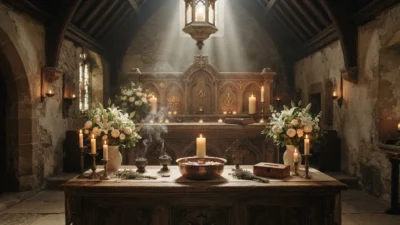
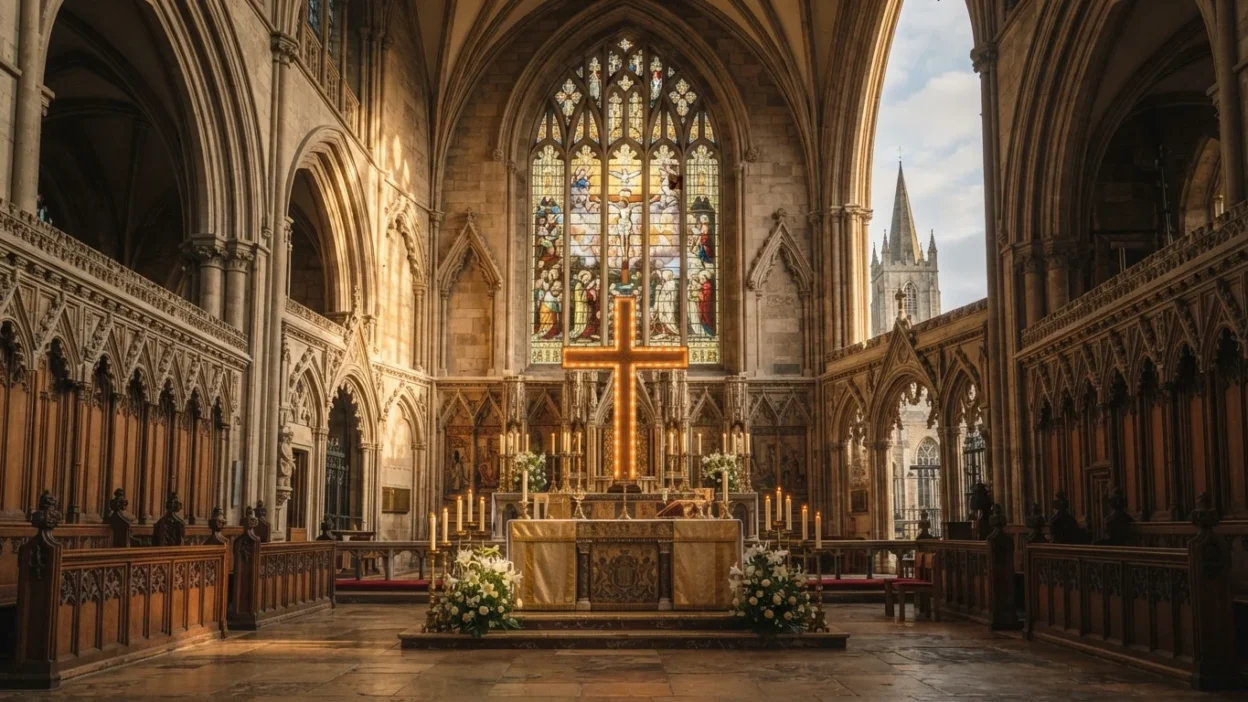
Church symbolism gives deeper meaning to the buildings, objects, colors, images, architecture, and rituals found in Christian places of worship. From the cross above an altar to stained-glass windows, candles, bells, and towering spires, these elements can communicate important ideas about faith, sacrifice, hope, salvation, and the presence of God.
Understanding church symbolism can make a visit to a church more meaningful. Many features that appear decorative at first actually carry centuries of religious tradition and spiritual significance.
Church symbols often communicate ideas visually. Instead of explaining a concept through a long passage, a single image or architectural feature can represent an entire religious teaching.
For example, a cross can symbolize Christ’s crucifixion and redemption, while light can represent divine truth, hope, and spiritual guidance.
Some common examples include:
| Church Symbol | Common Meaning |
|---|---|
| Cross | Sacrifice, salvation, redemption, Christian faith |
| Dove | Peace, purity, and the Holy Spirit |
| Candle | Christ, divine light, hope, prayer |
| Water | Baptism, cleansing, renewal, new life |
| Bread | Spiritual nourishment and the Eucharist |
| Wine | Christ’s blood and covenant in Christian tradition |
| Bell | Worship, announcement, spiritual calling |
| Stained glass | Biblical stories, divine light, sacred teaching |
| Church tower | Heavenward aspiration, visibility, spiritual identity |
The meaning of a symbol can vary between Christian denominations and historical periods, so context is important.
What Does Church Symbolism Represent?
Church symbolism represents many central ideas of Christianity, including faith, salvation, sacrifice, resurrection, divine presence, community, and eternal life.
Faith and Devotion
Religious symbols remind worshippers of their beliefs and encourage devotion. A cross, crucifix, icon, or sacred inscription can provide a visual focus for prayer and reflection.
Sacrifice and Redemption
The cross is perhaps the strongest example of Christian symbolism connected with sacrifice. It recalls the crucifixion of Jesus and, within Christian belief, the promise of redemption and salvation.
Resurrection and New Life
Churches often use light, flowers, rising forms, and other imagery to suggest resurrection and spiritual renewal.
The contrast between darkness and light can represent movement from death or despair toward hope and new life.
Divine Presence
The sanctuary, altar, candles, sacred artwork, and other elements can create a sense of reverence and remind worshippers of God’s presence.
Community
A church is not only a physical structure. It is also a gathering place for a religious community.
Rows of seating, communal worship spaces, baptismal areas, and shared rituals can symbolize unity and belonging.
Spiritual Meaning of Church Symbolism
The spiritual meaning of church symbolism often involves the journey of the believer.
Church architecture can guide a person physically through a space while also suggesting a spiritual movement—from ordinary life toward worship, reflection, and communion with God.
Light as Spiritual Guidance
Light is one of the most common forms of spiritual symbolism in churches.
Candles and sunlight passing through stained glass can represent divine illumination, truth, hope, and the presence of Christ.
The Altar as Sacred Focus
In many Christian traditions, the altar is one of the most important features of the church interior.
Its meaning varies by denomination, but it may represent sacrifice, communion, worship, or the central relationship between God and the congregation.
Water as Renewal
The baptismal font represents water’s powerful religious symbolism.
Baptism is associated with cleansing, spiritual renewal, initiation into Christian life, and a new relationship with God.
The Journey Toward God
The layout of some churches creates a sense of movement toward a focal point such as the altar, sanctuary, or apse.
This physical progression can symbolize the spiritual journey toward God.
Biblical / Religious Meaning of Church Symbolism
Many forms of church symbolism have roots in the Bible, early Christianity, Christian worship, and centuries of religious tradition.
The Bible itself contains rich symbolic imagery involving light, water, bread, wine, shepherds, sheep, trees, doors, stones, crowns, and heavenly realms.
The Cross
The cross is central to Christian symbolism because it recalls the crucifixion of Jesus Christ.
It can represent suffering and sacrifice, but also forgiveness, redemption, victory over death, and hope.
The Dove
The dove is strongly associated with the Holy Spirit in Christian tradition.
It can therefore symbolize peace, purity, divine presence, and spiritual transformation.
The Lamb
The lamb has deep biblical significance and is commonly connected with innocence, sacrifice, and Christ as the “Lamb of God.”
Christian artwork may use the lamb to communicate themes of sacrifice and salvation.
The Fish
The fish is an ancient Christian symbol.
Known as the ichthys, it became an important sign of Christian identity and faith. Its symbolism is associated with Jesus and early Christian communities.
The Shepherd
Images of Christ as the Good Shepherd communicate care, guidance, protection, and responsibility.
A shepherd leading sheep can symbolize Christ guiding believers and caring for His followers.
Bread and Wine
Bread and wine hold major significance in Christian worship, particularly in traditions that celebrate the Eucharist or Communion.
They can symbolize nourishment, covenant, sacrifice, remembrance, and participation in Christ.
Church Symbolism in History and Culture
Church symbolism developed over centuries as Christianity spread across different regions and cultures.
Early Christian communities used symbols such as the fish, anchor, dove, shepherd, and vine. Over time, churches incorporated increasingly complex visual traditions.
Architecture also became a form of religious communication.
Romanesque Churches
Romanesque churches often feature thick walls, rounded arches, massive structures, and relatively small windows.
Their solid appearance can create an atmosphere of permanence, stability, and protection.
Gothic Churches
Gothic architecture introduced soaring vertical forms, pointed arches, large stained-glass windows, and elaborate decoration.
The upward movement of Gothic architecture is often interpreted as expressing a desire to direct the mind and spirit toward heaven.
Stained Glass
Stained-glass windows became an especially powerful form of religious storytelling.
Before widespread literacy, visual scenes could communicate biblical narratives and religious teachings to worshippers.
Light passing through colored glass also created a dramatic spiritual atmosphere.
Church Bells
Church bells have historically announced worship, marked important moments, called communities together, and distinguished sacred time from ordinary daily life.
Their sound can therefore carry both practical and symbolic meaning.
Steeples and Spires
Church towers and spires often rise above surrounding buildings.
Their upward direction can symbolize heaven, spiritual aspiration, prayer, and the presence of the church within the wider community.
Church Symbolism in Literature and Art
Church symbolism plays a major role in Christian art and appears frequently in literature.
Artists have used churches, crosses, candles, angels, stained glass, bells, and religious architecture to explore faith, guilt, redemption, mortality, and hope.
In literature, a church may represent more than a place of worship.
It can symbolize refuge, tradition, judgment, community, isolation, spiritual conflict, or a character’s search for meaning.
Light and Darkness
Writers frequently use church light and darkness symbolically.
A character entering a dark church and discovering a beam of sunlight may represent movement from confusion toward understanding.
Bells
Church bells can symbolize memory, warning, celebration, death, or the passage of time.
Their meaning depends heavily on the surrounding story.
Doors
Church doors can represent invitation, transition, refuge, or the boundary between ordinary life and sacred space.
A character crossing a church threshold may therefore symbolize entering a different emotional or spiritual state.
Stained Glass
Stained glass can represent beauty emerging from darkness.
Because the glass transforms ordinary sunlight into colored patterns, writers and artists may use it as a metaphor for spiritual transformation or seeing reality differently.
Dream Meaning of Church Symbolism
Dreams involving churches can carry strong emotional and symbolic meanings. Their interpretation depends on the dreamer’s beliefs, experiences, and feelings toward religion.
Common interpretations include:
- Entering a church: Seeking guidance, comfort, belonging, or spiritual direction.
- Praying in a church: Looking for reassurance, forgiveness, answers, or inner peace.
- Seeing a bright church: Hope, clarity, faith, or emotional renewal.
- An empty church: Loneliness, spiritual questioning, nostalgia, or a desire for connection.
- A damaged church: A possible symbol of emotional conflict, changing beliefs, loss, or uncertainty.
- Church bells: An important realization, warning, announcement, memory, or significant life transition.
- A church altar: Reflection on commitment, sacrifice, devotion, or an important personal decision.
Dream symbolism is not universal. A church may feel comforting to one person and unsettling to another, so the emotions experienced during the dream are particularly important.
Modern Meaning of Church Symbolism
Church symbolism remains meaningful in modern society, both inside and outside formal worship.
Churches continue to use crosses, candles, stained glass, religious artwork, baptismal fonts, bells, and sacred architecture to communicate Christian beliefs.
At the same time, church buildings have become important cultural and historical landmarks.
People may visit churches because of their architecture, artistic heritage, family history, weddings, funerals, music, or connection to local communities.
Modern Christian communities may also interpret traditional symbols through contemporary experiences.
For example, a candle may represent hope during a difficult period, while a cross may represent personal faith, family heritage, or resilience.
The continued use of church symbolism shows how ancient visual traditions can remain meaningful in modern life.
Why Is Church Symbolism Important?
Church symbolism is important because it communicates complex religious ideas through recognizable visual forms.
A symbol can help worshippers remember teachings, focus during prayer, understand biblical stories, and feel connected to generations of believers.
It also gives churches a distinctive spiritual identity.
Architecture, artwork, music, objects, and rituals work together to create an environment designed to encourage reflection and worship.
Common Church Symbols and Their Meanings
Some of the most recognizable church symbols include:
- Cross: Faith, sacrifice, redemption, and salvation.
- Crucifix: Christ’s suffering and crucifixion.
- Dove: Holy Spirit, peace, and purity.
- Fish: Christian faith and identity.
- Lamb: Innocence, sacrifice, and Christ.
- Candle: Divine light, prayer, hope, and Christ.
- Water: Baptism, cleansing, renewal, and new life.
- Anchor: Hope, stability, and steadfast faith.
- Vine: Spiritual connection, growth, and life.
- Alpha and Omega: God as the beginning and the end.
- Halo: Holiness and sanctity.
- Bell: Calling people to worship and marking sacred time.
These meanings provide a useful starting point, but individual traditions may give particular symbols additional interpretations.
Frequently Asked Questions About Church Symbolism
What is the meaning of church symbolism?
Church symbolism uses objects, architecture, colors, images, and rituals to communicate Christian beliefs and spiritual ideas such as faith, salvation, sacrifice, and hope.
What is the most important symbol in a church?
The cross is generally the most recognizable Christian symbol. It represents the crucifixion of Jesus Christ and is associated with sacrifice, redemption, salvation, and faith.
What does a church symbolize spiritually?
A church can symbolize a sacred meeting place between people and God, as well as community, worship, refuge, spiritual growth, and belonging.
Why do churches use stained glass?
Stained glass can communicate biblical stories and Christian teachings through images while using light symbolically to suggest divine truth, beauty, and spiritual illumination.
What does dreaming about a church mean?
Dreaming about a church may symbolize a search for guidance, peace, belonging, forgiveness, or spiritual understanding. The personal emotions and circumstances surrounding the dream are important to its interpretation.
Conclusion
Church symbolism transforms ordinary spaces, objects, and images into reminders of deeper spiritual ideas. From the cross and candle to stained glass, water, bells, and soaring architecture, each element can connect visible experiences with faith, hope, sacrifice, and divine meaning.
Ultimately, church symbolism reminds us that sacred meaning can be found not only in words but also in light, shape, sound, color, space, and tradition.

Miles Arthur is a passionate content writer at Symblosim.com, specializing in symbol meanings, cultural symbolism, spiritual interpretations, and historical signs. He creates informative articles that help readers understand the deeper significance of symbols.