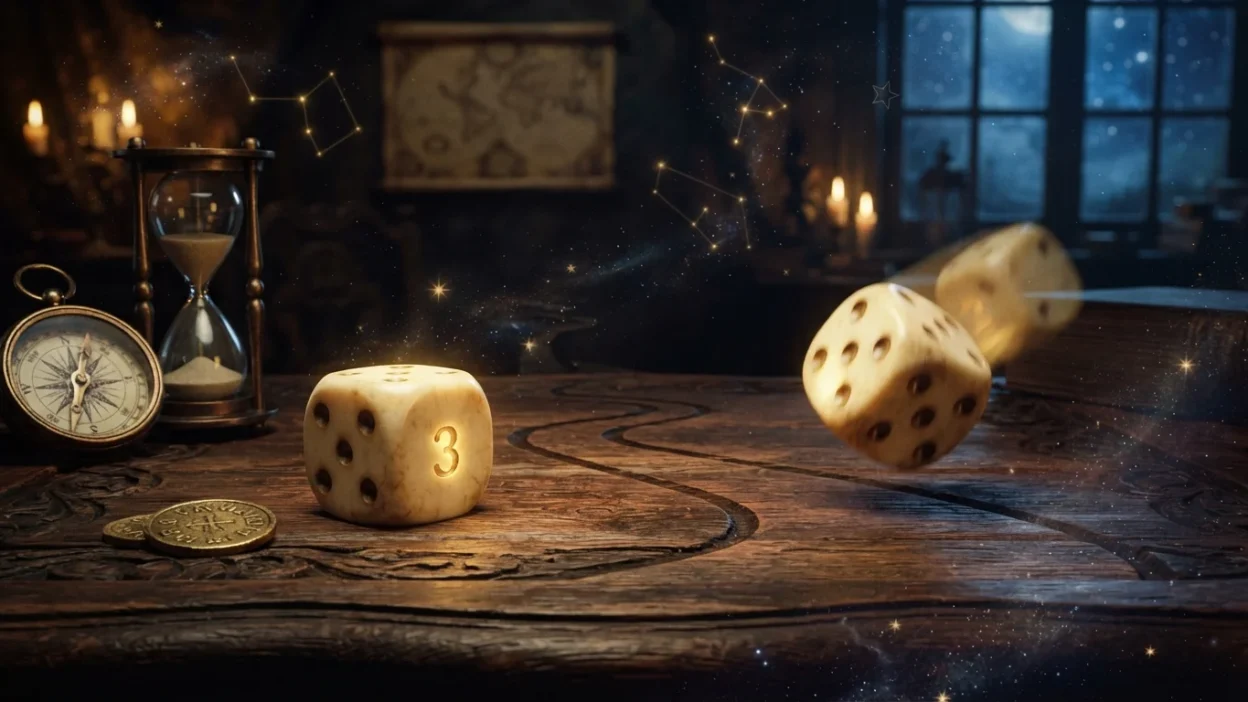
Dice symbolism explores the deeper meanings associated with dice, chance, fate, risk, uncertainty, choice, and the unpredictable nature of life. Although dice are commonly used in games, their simple shape and random outcomes have made them powerful symbols across cultures and throughout history.
A roll of the dice can represent a moment when control gives way to possibility. Because the outcome cannot be known beforehand, dice often symbolize the balance between luck and choice, destiny and free will, risk and reward.
Dice Symbolism Meaning (Clear Definition)
Dice symbolism refers to the ideas and meanings traditionally associated with dice and their unpredictable outcomes.
In simple terms, dice symbolize chance and uncertainty. Rolling dice creates multiple possible outcomes, making them a natural metaphor for life’s unexpected turns.
Common meanings associated with dice include:
- Chance — outcomes that cannot be completely controlled
- Luck — favorable or unfavorable circumstances
- Fate — the idea that events may be influenced by forces beyond personal control
- Risk — accepting uncertainty in pursuit of a possible reward
- Choice — deciding whether to take a chance
- Uncertainty — not knowing what will happen next
- Transformation — one unexpected result changing a situation
The meaning of dice depends greatly on the cultural, religious, artistic, or personal context in which they appear.
What Does Dice Symbolism Represent?
Dice symbolism primarily represents the unpredictable side of existence.
Unlike a carefully planned action, rolling dice produces an outcome that cannot be known in advance. This makes dice a natural symbol for situations where humans must act without complete certainty.
| Dice Symbol | Common Symbolic Meaning |
|---|---|
| Roll of the dice | Chance, uncertainty, possibility |
| One | Individuality, beginning, independence |
| Two | Balance, duality, partnership |
| Three | Growth, creativity, development |
| Six | Completion, harmony, achievement |
| High roll | Success, opportunity, favorable luck |
| Low roll | Disappointment, limitation, setback |
| Pair of dice | Duality, choices, competing possibilities |
| Golden dice | Fortune, wealth, opportunity |
| Broken die | Lost control, disrupted plans, unexpected change |
These are symbolic associations rather than universal definitions.
Dice and the Idea of Fate
Dice are especially connected with fate and destiny because their outcome is uncertain.
When someone rolls dice, they may influence the situation by choosing to participate, but they cannot determine the exact result. This creates an interesting symbolic contrast between human agency and forces beyond human control.
That tension has made dice a lasting metaphor for life itself.
Spiritual Meaning of Dice Symbolism
Spiritually, dice symbolism can represent surrender, trust, uncertainty, and acceptance of life’s changing circumstances.
A die has many possible outcomes, but only one becomes reality when it is rolled. Symbolically, this can represent the countless possibilities that exist before a decision or life event takes place.
Dice may therefore symbolize:
- Trusting the journey
- Accepting uncertainty
- Letting go of excessive control
- Taking calculated risks
- Recognizing life’s unpredictability
- Learning from unexpected outcomes
- Embracing new possibilities
For some people, dice can also symbolize a reminder that uncertainty does not necessarily mean something negative. Sometimes the unknown creates opportunities that could never have been planned.
Biblical / Religious Meaning of Dice Symbolism
Dice have a complicated religious history, and their meaning differs across traditions.
In the Christian Bible, casting lots appears in several passages as a way of making decisions or determining outcomes. While casting lots is not necessarily identical to modern dice, the imagery is often discussed when examining historical ideas about chance, providence, and decision-making.
Dice have also sometimes been associated with gambling, which has led many religious traditions to emphasize caution around games involving money, greed, or exploitation.
Symbolically, dice can therefore raise questions about:
- Divine providence
- Human uncertainty
- Fate and decision-making
- Trust
- Temptation
- Material desire
Their religious interpretation depends heavily on context. A die used as a game object does not automatically carry a religious meaning.
Dice Symbolism in History and Culture
Dice are among the oldest gaming objects known to humanity.
Ancient forms of dice have been discovered in archaeological contexts across different civilizations. Early dice were made from materials such as bone, ivory, wood, stone, and other available substances.
They were used for games, entertainment, divination, and decision-making.
The connection between dice and chance became particularly powerful because rolling them creates an immediate and visible outcome. This made dice useful not only for games but also as cultural symbols of uncertainty and fortune.
Throughout history, dice have been associated with:
- Games and entertainment
- Gambling
- Fortune
- Military decisions
- Divination
- Social competition
- Risk-taking
- Fate and destiny
Their simplicity helped them survive across generations while their meanings continued to evolve.
Dice Symbolism in Literature and Art
Writers and artists frequently use dice as symbols of chance, danger, fate, and unpredictable circumstances.
A character who rolls dice may be taking a serious risk or surrendering control over an important decision. A pair of dice on a table can create an atmosphere of suspense because the audience knows that the next outcome is uncertain.
Dice can also symbolize the randomness of life.
A novelist might use a dice roll to represent a character’s attempt to escape a difficult situation. A painter might place dice beside money or cards to explore themes of gambling, greed, and fortune.
In visual culture, dice can communicate an entire story with very little imagery.
Dream Meaning of Dice Symbolism
Dreaming about dice often relates to risk, uncertainty, choices, luck, and concerns about the future.
The details of the dream can influence its possible meaning.
Common interpretations include:
- Rolling dice — taking a risk or facing uncertainty
- Winning with dice — confidence, optimism, or hope for a favorable outcome
- Losing with dice — fear of failure or concern about losing control
- Seeing a single die — an important choice or limited possibility
- Seeing multiple dice — competing options or many possible outcomes
- Broken dice — disrupted expectations or a situation that no longer follows the usual rules
- Golden dice — ambition, wealth, opportunity, or desire for success
- Repeatedly rolling the same number — feeling stuck in a pattern or searching for a particular outcome
Dream interpretation is personal. The strongest clue is often how you felt during the dream and what uncertain situation you are currently experiencing.
Modern Meaning of Dice Symbolism
In modern culture, dice remain closely connected with games, probability, risk, entertainment, and chance.
They appear in board games, tabletop role-playing games, casinos, educational activities, art, jewelry, tattoos, clothing, and popular media.
A pair of dice can also function as a personal symbol.
Someone may wear dice imagery to express a willingness to take risks, embrace adventure, or accept uncertainty. Others may associate dice with nostalgia, competition, friendship, or memorable gaming experiences.
Modern dice symbolism can therefore be both serious and playful.
Dice Symbolism in Games and Probability
Dice are also useful symbols because they demonstrate probability in a simple physical form.
A standard six-sided die has six possible faces. When it is fair, each face has an equal theoretical probability of appearing on a single roll.
This mathematical quality reinforces the symbolic connection between dice and uncertainty. Although probability can describe the possible outcomes, it cannot tell you with certainty what one individual roll will produce.
That distinction mirrors many real-life situations: we can understand possibilities without being able to control every result.
Dice as a Symbol of Risk and Choice
One of the most powerful aspects of dice symbolism is the relationship between risk and personal choice.
But once the die is released, the exact result is outside your control.
This makes dice a useful metaphor for decisions in relationships, careers, travel, business, creativity, and personal growth.
Sometimes progress requires accepting that complete certainty is impossible.
Why Are Dice Symbolically Powerful?
Dice are symbolically powerful because they capture a universal human experience: not knowing what comes next.
Everyone encounters moments when careful planning cannot eliminate uncertainty. Dice give that uncertainty a physical form.
They can remind us that life contains both controllable and uncontrollable elements. We make choices, prepare for possibilities, and take risks, but outcomes can still surprise us.
In this way, dice symbolize not only luck but also courage—the willingness to move forward despite uncertainty.
FAQs About Dice Symbolism
What does dice symbolism mean?
Dice symbolism commonly represents chance, luck, risk, uncertainty, fate, and unpredictable outcomes. It can also symbolize the balance between personal choice and circumstances beyond our control.
What do dice symbolize spiritually?
Spiritually, dice may symbolize surrender, trust, acceptance of uncertainty, and openness to unexpected possibilities. Their meaning can vary according to personal beliefs.
What does rolling dice symbolize?
Rolling dice often symbolizes taking a chance, making a decision without certainty, or accepting whatever outcome follows an action.
What does dreaming about dice mean?
Dreaming about dice may represent uncertainty, risk, choices, luck, or anxiety about an unpredictable situation. Personal emotions and circumstances can influence the interpretation.
Are dice symbols associated with luck?
Yes. Dice are widely associated with luck because their outcomes are uncertain and can produce favorable or unfavorable results. Their symbolism often connects luck with risk and chance.
Conclusion
Dice symbolism captures one of life’s oldest mysteries: the uncertainty of what comes next. A simple roll can represent fate, risk, luck, choice, and the courage to accept an unknown outcome.
Whether seen in ancient games, modern entertainment, dreams, literature, or personal symbolism, dice remind us that while we cannot control every result, we can choose how we respond to whatever life rolls our way.

Miles Arthur is a passionate content writer at Symblosim.com, specializing in symbol meanings, cultural symbolism, spiritual interpretations, and historical signs. He creates informative articles that help readers understand the deeper significance of symbols.