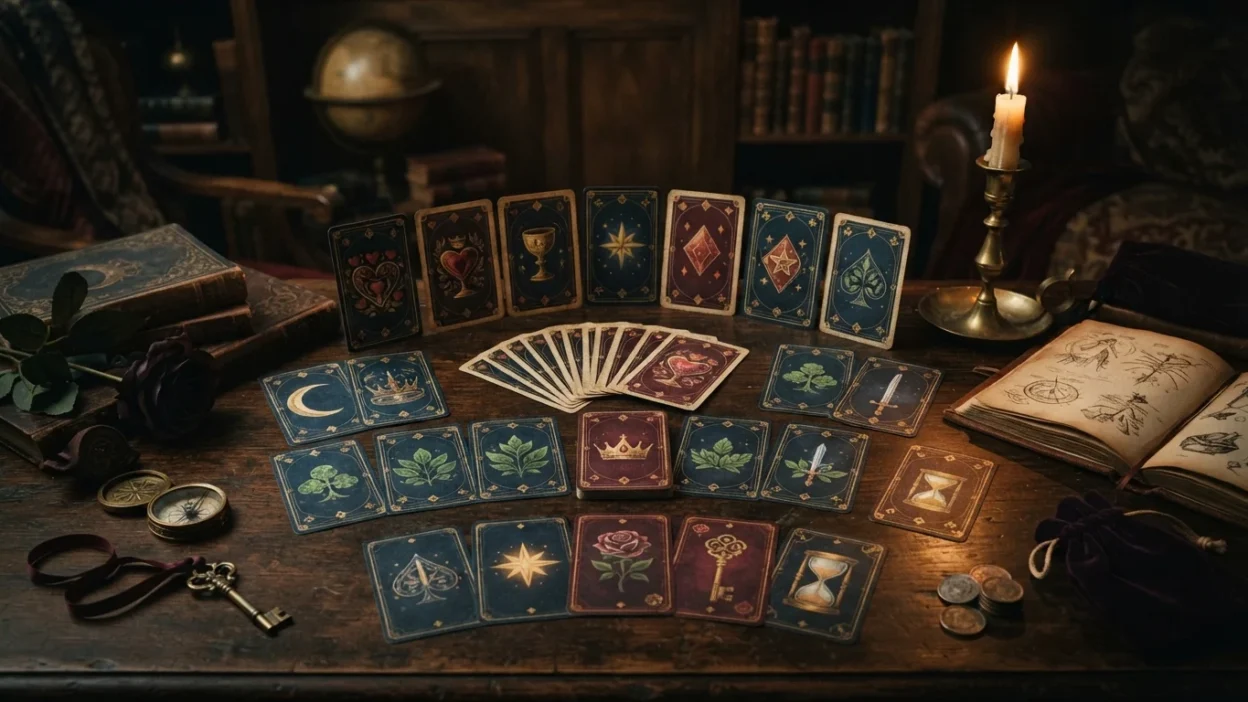
Card symbolism refers to the meanings represented by cards through their images, numbers, colors, suits, characters, and visual details. Cards can communicate ideas far beyond their practical purpose, making them powerful symbols of identity, chance, choice, relationships, memory, and transformation.
From playing cards and tarot cards to greeting cards and symbolic artworks, cards have been used across cultures to tell stories and express ideas. Understanding card symbolism can reveal how ordinary objects become meaningful representations of human experiences.
Card Symbolism Meaning (Clear Definition)
Card symbolism is the use of visual elements, patterns, numbers, suits, images, and objects on a card to communicate a deeper meaning.
In simple terms, card symbolism turns a card into a visual message. Its meaning depends on the type of card, its cultural background, and the context in which it appears.
Common symbolic elements include:
- Numbers — cycles, stages, quantity, or progression
- Colors — emotions, qualities, moods, or spiritual ideas
- Suits — different areas of life or human experience
- Figures — personality traits, roles, or archetypes
- Animals — instincts, qualities, protection, or transformation
- Objects — authority, love, work, conflict, or communication
- Patterns — order, repetition, balance, or connection
Because different card traditions use different visual languages, there is no single universal interpretation.
What Does Card Symbolism Represent?
Card symbolism can represent some of the most familiar themes in human life.
Depending on the card system, symbols may represent luck, destiny, relationships, power, knowledge, conflict, creativity, opportunity, or personal change.
The following table summarizes common symbolic associations:
| Card ElementCommon Symbolic Meaning | |
|---|---|
| Heart | Love, emotion, affection |
| Diamond | Wealth, value, material concerns |
| Club | Energy, action, ambition |
| Spade | Thought, challenge, authority |
| Crown | Power, achievement, leadership |
| Star | Hope, guidance, inspiration |
| Moon | Mystery, intuition, emotions |
| Sun | Vitality, clarity, success |
| Flower | Growth, beauty, renewal |
| Key | Knowledge, access, opportunity |
| Sword | Conflict, truth, decision |
| Cup | Emotion, relationships, intuition |
These meanings can change according to the cultural or symbolic system being used.
Spiritual Meaning of Card Symbolism
Spiritually, card symbolism can represent guidance, reflection, intuition, transformation, and the search for meaning.
Symbolic cards often encourage people to look beyond surface appearances. A simple image can become a reminder of an emotional state, personal goal, spiritual question, or important life transition.
Common spiritual themes associated with card symbolism include:
- Inner wisdom
- Personal growth
- Intuition
- Life cycles
- Transformation
- Protection
- Hope
- Destiny
- Self-reflection
For some people, symbolic cards are part of spiritual or divination practices. Others simply appreciate their imagery as a way of exploring thoughts and emotions.
Biblical / Religious Meaning of Card Symbolism
Card symbolism does not have one universal biblical meaning.
Religious interpretations depend on the type of cards being considered. Playing cards, tarot cards, religious cards, and devotional cards can have very different cultural and spiritual backgrounds.
Some card imagery incorporates familiar religious symbols such as:
- Crosses
- Angels
- Doves
- Crowns
- Stars
- Light
- Water
- Shepherds
- Sacred figures
These symbols may represent faith, sacrifice, divine guidance, peace, hope, or spiritual transformation.
However, religious traditions differ considerably in how they view divination, fortune-telling, and symbolic card practices. Therefore, a card’s religious meaning should always be understood within its specific cultural and theological context.
Card Symbolism in History and Culture
Cards have a long and fascinating history.
Playing cards became established in Europe during the late medieval period after earlier card traditions had developed in Asia and the Islamic world. Over time, different cultures created their own suits, designs, illustrations, and symbolic conventions.
The familiar hearts, diamonds, clubs, and spades eventually became strongly associated with Western playing cards.
Cards have also been connected with games, gambling, entertainment, fortune-telling, education, storytelling, and social interaction.
Their portability made them especially effective as cultural objects. A small deck could carry a surprisingly rich visual language from one generation to another.
Card Symbolism in Literature and Art
Card imagery has inspired writers and artists for centuries.
In literature, cards often symbolize chance, uncertainty, fate, deception, competition, and destiny. A character holding a card may represent someone taking a risk or waiting for an unknown outcome.
The metaphor of “playing one’s cards” can suggest revealing information, while keeping cards hidden can symbolize secrecy or strategy.
Artists have also used cards to explore themes of:
- Luck and randomness
- Wealth and social class
- Competition
- Identity
- Mortality
- Fate
- Illusion
- Power
A simple playing card can therefore become much more than a game object when placed within a larger artistic or literary context.
Dream Meaning of Card Symbolism
Dreaming about cards may symbolize choices, uncertainty, risk, hidden information, or expectations about the future.
The details of the dream can change the interpretation.
Common symbolic possibilities include:
- Playing cards — competition, risk, strategy, or uncertainty
- Tarot cards — guidance, intuition, self-reflection, or unanswered questions
- A winning card — confidence, opportunity, or hope for success
- A losing card — fear of failure, disappointment, or uncertainty
- A hidden card — secrecy or information not yet revealed
- A damaged card — a disrupted plan, lost opportunity, or changing expectation
- Receiving a card — communication, recognition, or an unexpected message
Dream symbolism is highly personal. The emotions you experienced during the dream and your current circumstances may provide more useful clues than any fixed interpretation.
Modern Meaning of Card Symbolism
Today, card symbolism appears in many areas of everyday life.
Playing cards remain popular for games, while tarot and oracle cards are widely used for spiritual reflection and personal exploration. Cards are also used in advertising, branding, greeting cards, education, collectible games, and visual art.
Modern card symbolism often combines traditional meanings with contemporary design.
A card might represent:
- Personal identity
- A relationship
- A memory
- A life milestone
- A challenge
- A goal
- A message
- A personal belief
Digital culture has also expanded the idea of cards. Virtual cards, collectible digital designs, game cards, and personalized messages continue the long tradition of using compact visual objects to communicate meaning.
Playing Card Symbolism and the Four Suits
The four traditional Western playing-card suits are especially rich in symbolism.
Hearts
Hearts are commonly associated with love, emotions, relationships, compassion, and matters of the heart.
Diamonds
Diamonds can symbolize value, wealth, material resources, ambition, and practical concerns.
Clubs
Clubs are sometimes associated with action, energy, growth, work, or determination.
Spades
Spades can carry associations with intellect, challenges, authority, conflict, and serious decisions.
These interpretations are cultural associations rather than universal rules. Different traditions may assign different meanings to the suits.
Number Symbolism in Cards
Numbers add another layer of meaning to card symbolism.
An Ace can represent beginnings, potential, or individuality. A Two may suggest partnership, balance, or duality. A Three can represent growth, creativity, or development.
Higher numbers may symbolize progression, completion, accumulation, or changing circumstances.
In games, numbers primarily have practical functions. In symbolic systems, however, they can also become visual shorthand for stages and patterns.
Why Is Card Symbolism Important?
Card symbolism is important because it shows how ordinary objects can carry extraordinary meaning.
A small card can represent love, risk, opportunity, loss, identity, or hope depending on the imagery surrounding it. This makes cards useful in storytelling, art, spiritual practices, games, and cultural traditions.
The deeper lesson is that symbols gain meaning through the stories humans attach to them.
FAQs About Card Symbolism
What does card symbolism mean?
Card symbolism is the use of images, colors, numbers, suits, and visual elements on cards to communicate ideas beyond their practical purpose.
What do playing cards symbolize?
Playing cards can symbolize luck, chance, competition, strategy, risk, relationships, wealth, and uncertainty depending on their suit and context.
What do the four card suits symbolize?
Hearts are commonly linked with emotions, diamonds with value and material concerns, clubs with action, and spades with challenges or intellect.
What does dreaming about cards mean?
Dreaming about cards may symbolize choices, uncertainty, risk, hidden information, or expectations about the future. The dreamer’s personal circumstances are important when interpreting it.
Is card symbolism always spiritual?
No. Card symbolism can be spiritual, cultural, artistic, psychological, recreational, or purely decorative depending on the type of card and its context.
Conclusion
Card symbolism transforms simple cards into meaningful visual objects that can represent luck, love, uncertainty, choice, identity, and transformation. From traditional playing cards to tarot imagery and modern designs, cards continue to reflect the stories and ideas people attach to them.
Ultimately, card symbolism reminds us that meaning is not always found in the object itself, but in the symbols, experiences, and stories we see within it.