Karma symbolism explores the signs and ideas associated with cause and effect, moral responsibility, consequences, balance, and spiritual growth. Rooted in ancient Indian religious and philosophical traditions, karma has become a widely recognized concept far beyond its original contexts.
Symbols connected with karma often suggest that actions have consequences and that life can involve cycles of learning, transformation, and responsibility. Common themes include cause and effect, balance, justice, reincarnation, intention, consequences, and spiritual growth.
Karma Symbolism Meaning (Clear Definition)
Karma symbolism represents the principle that actions, intentions, and choices can produce consequences that influence a person’s experiences and spiritual development.
The word karma comes from Sanskrit and is broadly associated with action or deed. In traditions such as Hinduism, Buddhism, and Jainism, karma has developed complex meanings and should not simply be reduced to the idea that “what goes around comes around.”
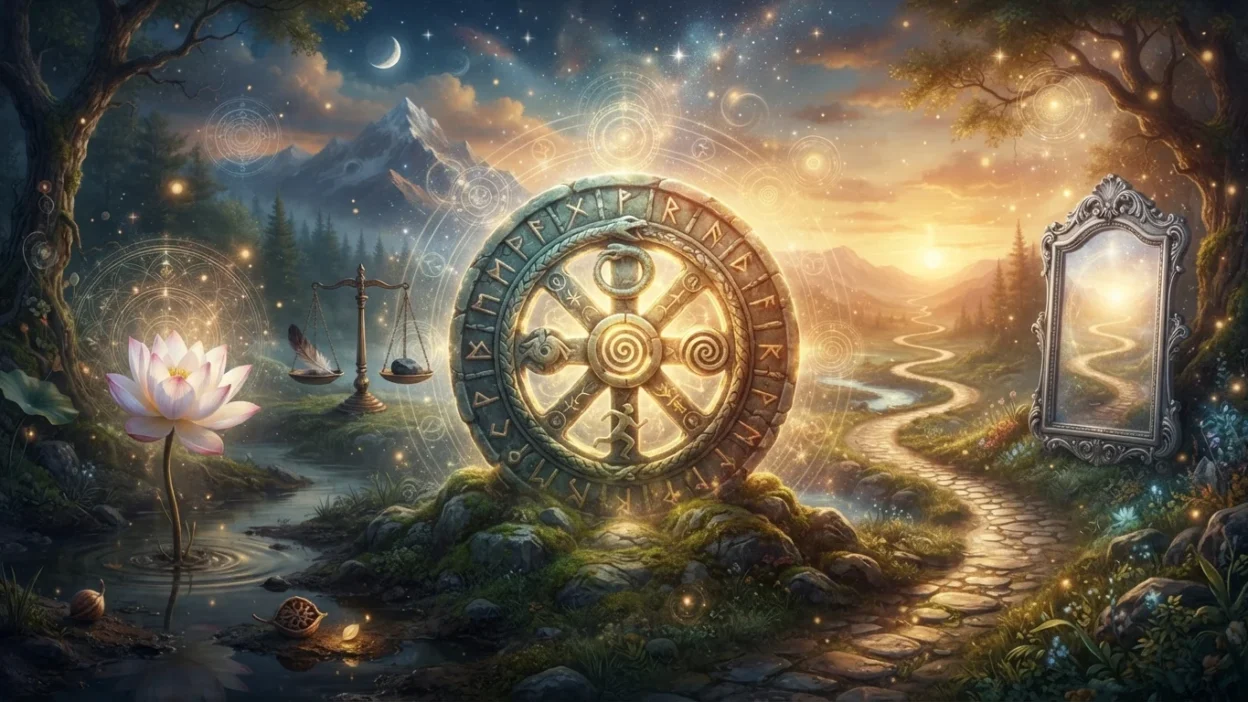
In symbolic terms, karma can represent:
| Symbol | Common Symbolic Meaning |
|---|---|
| Wheel | Cycles, rebirth, and continuous change |
| Balance scales | Moral balance and consequences |
| Circle | Cycles of action and result |
| Seed | Actions producing future results |
| Mirror | Reflection of one’s choices |
| Knot | Attachments and unresolved consequences |
| Path | Spiritual journey and personal responsibility |
| Lotus | Growth, awakening, and transformation |
| Fire | Purification and change |
| Cause-and-effect chain | The connection between actions and outcomes |
What Does Karma Symbolism Represent?
Karma symbolism can represent several important ideas about human behavior and spiritual development.
1. Cause and Effect
The central symbolic meaning of karma is cause and effect. Actions are connected to consequences, creating an ongoing relationship between what people do and what follows.
2. Responsibility
Karma can symbolize personal responsibility. It encourages people to consider the intentions behind their actions and the effects those actions may have on others.
3. Moral Balance
Karma is often represented through images of balance. These symbols suggest that actions have significance and contribute to a larger moral or spiritual order.
4. Spiritual Growth
Karma can symbolize learning through experience. Difficult situations may become opportunities for reflection, ethical development, and greater awareness.
5. Cycles
Wheels and circles frequently represent karmic cycles. These may symbolize repeated patterns, rebirth, or the continuation of cause and effect.
6. Intention
In several Buddhist teachings, intention plays a particularly important role in karma. This means that the motivation behind an action matters, not simply the external action itself.
7. Transformation
Karma symbolism can represent the possibility of changing future outcomes through wiser choices and greater awareness.
Spiritual Meaning of Karma Symbolism
Spiritually, karma symbolism represents conscious action, moral responsibility, spiritual lessons, transformation, balance, and the long-term effects of intention.
Rather than viewing karma simply as punishment or reward, many traditional teachings present it as part of a complex process involving action, consequence, attachment, consciousness, and liberation.
The symbolic image of a seed is especially useful. A seed contains the potential for future growth, just as an action can contribute to later consequences.
The wheel is another important symbol because it represents cycles of existence and repeated patterns.
Karma symbolism can therefore encourage people to become more mindful of their actions. It asks a simple but powerful question:
What kind of future are today’s choices helping to create?
Biblical / Religious Meaning of Karma Symbolism
Karma is not a biblical concept in the same technical sense in which it appears in Hinduism, Buddhism, and Jainism.
Christian teachings do contain ideas about moral consequences, accountability, repentance, justice, and the relationship between actions and outcomes. However, these should not be treated as identical to karma.
In Hindu traditions, karma is connected with action, dharma, rebirth, and spiritual liberation.
In Buddhism, karma is strongly associated with intentional action and its consequences, while the concept is understood within teachings about suffering, rebirth, and liberation.
Jainism has its own distinctive understanding of karma, including karma as something that binds the soul and can be overcome through ethical and spiritual discipline.
Because these traditions differ significantly, it is important to avoid treating “karma” as a single belief with exactly the same meaning everywhere.
Karma Symbolism in History and Culture
Karma developed within the religious and philosophical traditions of ancient India.
The concept appears in early Indian religious literature and became increasingly developed through Hindu, Buddhist, and Jain philosophical traditions.
Over centuries, karma became connected with questions about ethics, rebirth, liberation, intention, suffering, and spiritual practice.
The karma wheel or related circular imagery reflects the idea of cycles and continuity. The seed is another useful metaphor because it suggests that actions can generate future results.
In modern global culture, karma has also taken on a simplified meaning. People often use the phrase “good karma” to describe kindness or “bad karma” to describe wrongdoing eventually producing negative consequences.
This everyday usage captures part of the concept but does not represent the full philosophical depth of traditional teachings.
Karma Symbolism in Literature and Art
Karma symbolism provides writers and artists with powerful ways to explore morality, justice, destiny, and transformation.
A character may make a selfish choice early in a story and later face consequences connected with that decision. Another character may act compassionately and experience unexpected positive consequences.
Literature can also use karmic cycles to show how unresolved behavior repeats across generations or stages of life.
Common artistic symbols include:
- Wheel: Cycles of existence and change
- Seed: Future consequences developing from present actions
- Mirror: Reflection and self-awareness
- Scales: Balance and moral consequence
- Lotus: Spiritual growth
- Path: Ethical and spiritual development
- Circle: Continuity and recurring patterns
- Fire: Purification and transformation
These symbols allow abstract philosophical ideas to become visible and emotionally understandable.
Dream Meaning of Karma Symbolism
Dreams involving karma may symbolize self-reflection, guilt, responsibility, unresolved experiences, moral choices, or the desire to correct past behavior.
The dream does not necessarily predict karmic punishment or reward. It may instead reflect how your mind is processing choices and consequences.
Dreaming About Karma
This may indicate that you are thinking about how a past action affected you or someone else.
Dreaming About Balance Scales
Scales can symbolize fairness, accountability, or an internal desire to restore balance.
Dreaming About a Karma Wheel
A spinning wheel may represent repeating patterns in your life. It could encourage you to examine habits or situations that continue to return.
Dreaming About a Seed
A seed can symbolize an action or decision whose consequences have not yet become visible.
Dreaming About a Mirror
A mirror may represent self-examination. It can suggest that you are becoming more aware of your intentions, choices, or behavior.
Dream interpretation is personal, so the emotions and circumstances surrounding the dream are important.
Modern Meaning of Karma Symbolism
Modern culture often uses karma as a simple way to describe moral cause and effect.
Someone may say that a generous act created “good karma” or that harmful behavior resulted in “bad karma.” Social media has also popularized karma as a shorthand for seeing people eventually experience consequences similar to those they caused.
Although this usage can be meaningful, traditional concepts of karma are much more nuanced.
Modern karma symbolism can still provide a useful reminder about accountability, empathy, intentional behavior, and long-term consequences.
It encourages people to think beyond immediate results and consider how repeated choices shape relationships, habits, character, and future possibilities.
Karma Symbolism and the Law of Cause and Effect
Karma is often compared with the general principle of cause and effect, but the two ideas are not identical.
Cause and effect is a broad concept used to describe relationships between events. Karma traditionally involves ethical, intentional, and spiritual dimensions that vary between religious and philosophical systems.
For example, a physical cause may produce a physical result without having any moral significance. Karma, by contrast, is concerned with action and its consequences within particular spiritual frameworks.
This distinction helps explain why karma is more than simply “what happens next.”
Good Karma and Bad Karma Symbolism
In everyday language, good karma commonly symbolizes kindness, generosity, honesty, and compassion.
Bad karma is often used to symbolize harmful behavior, selfishness, dishonesty, or actions that create suffering.
However, traditional teachings are more complex than a simple reward-and-punishment system.
Karma is connected with intention, ethical conduct, consciousness, and broader spiritual processes. It should therefore not be interpreted as a simplistic guarantee that every good action immediately produces a good outcome.
Karma Symbolism and Personal Growth
One of the most inspiring aspects of karma symbolism is its connection with personal growth.
If actions contribute to future consequences, then greater awareness can change how a person behaves.
Instead of focusing only on whether someone deserves a reward or punishment, karmic symbolism can encourage deeper questions:
- What motivates my actions?
- How do my choices affect others?
- Which patterns keep repeating in my life?
- What can I learn from difficult experiences?
- What kind of person am I becoming?
These questions turn karma from a concept about judgment into an opportunity for self-reflection.
Is Karma the Same as Revenge?
No. Karma is not simply spiritual revenge.
The popular phrase “karma will get them” often suggests that someone will eventually suffer because they caused harm. Traditional concepts of karma are much more sophisticated and are not simply about personal revenge or immediate punishment.
Karma is better understood through ideas such as action, intention, consequence, ethical responsibility, and spiritual development.
Frequently Asked Questions About Karma Symbolism
What does karma symbolism mean?
Karma symbolism represents cause and effect, moral responsibility, consequences, balance, spiritual growth, and recurring patterns of action and result.
What is the spiritual meaning of karma?
Spiritually, karma can symbolize intentional action, ethical responsibility, learning, transformation, and the consequences of behavior within a broader spiritual journey.
What is the most common symbol of karma?
The wheel is one of the most recognizable symbols associated with karma because it can represent cycles, change, rebirth, and the continuing relationship between actions and consequences.
What does dreaming about karma mean?
Dreaming about karma may reflect guilt, responsibility, self-reflection, unresolved experiences, or concern about the consequences of personal choices.
Is karma always about punishment?
No. Karma is not simply punishment or revenge. Traditional interpretations involve complex ideas about action, intention, consequence, spiritual development, and liberation.
Conclusion
Karma symbolism offers a powerful reminder that actions and intentions can have consequences. Its deeper meaning is not simply about receiving rewards or punishment, but about awareness, responsibility, ethical choices, and personal transformation.
Whether represented by a wheel, seed, mirror, path, or circle, karma symbolism invites us to look closely at the patterns we create. Every choice can become part of a larger journey, and greater awareness can help us choose that journey more wisely.

Miles Arthur is a passionate content writer at Symblosim.com, specializing in symbol meanings, cultural symbolism, spiritual interpretations, and historical signs. He creates informative articles that help readers understand the deeper significance of symbols.