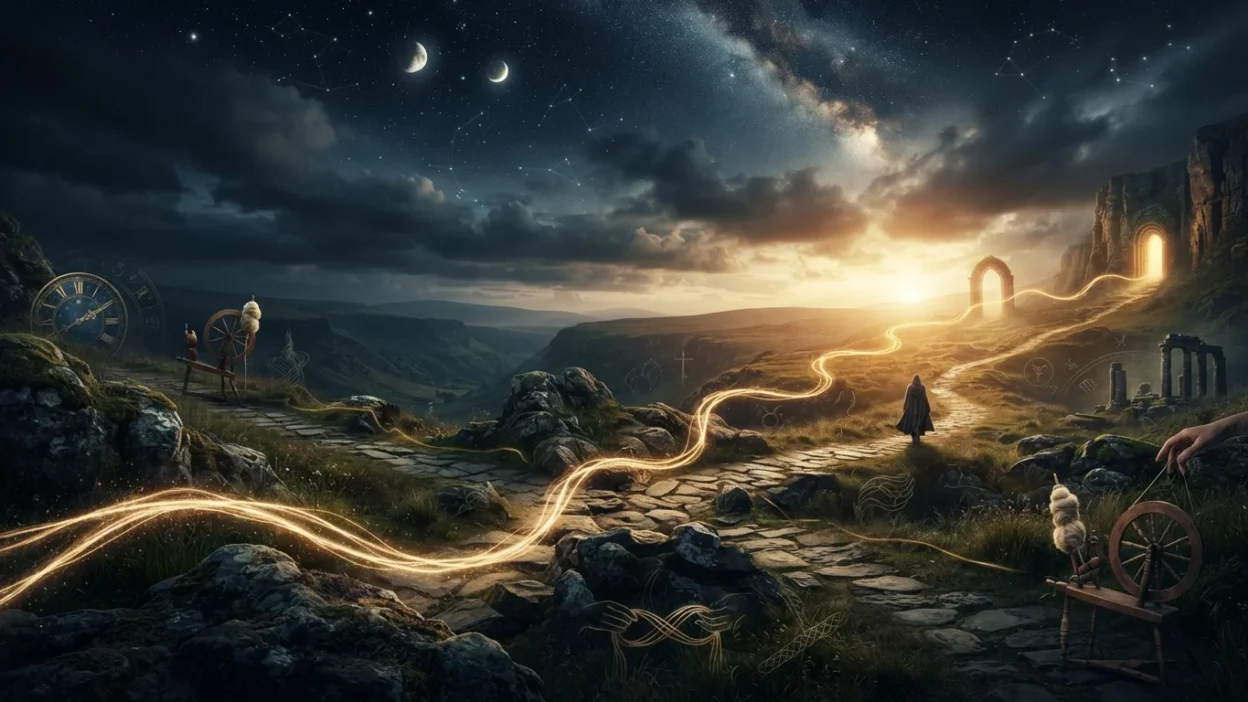
Fate symbolism explores the signs, objects, figures, and ideas people have used to represent destiny, predetermined events, life paths, and forces beyond human control. Across cultures, fate has been imagined as a mysterious power that shapes important moments in human life.
Symbols of fate often include threads, wheels, stars, clocks, crossroads, scales, doors, and journeys. These images can represent destiny, choice, timing, uncertainty, and the turning points that shape a person’s story.
In simple terms, fate symbolism can represent:
| Symbol | Common Meaning |
|---|---|
| Thread | Connection, destiny, and the course of life |
| Wheel | Cycles, changing circumstances, and fortune |
| Crossroads | Choice, uncertainty, and life-changing decisions |
| Stars | Destiny, guidance, and cosmic influence |
| Clock | Time, inevitability, and mortality |
| Scales | Balance, justice, and consequences |
| Door | Opportunity, transition, and an unknown future |
| Road | Life journey and personal direction |
| Knot | Bonds, connections, and unavoidable ties |
| Broken chain | Freedom from a predetermined path |
What Does Fate Symbolism Represent?
Fate symbolism can communicate several ideas about human existence and the forces that shape our lives.
1. Destiny
The most direct meaning of fate symbolism is destiny. It suggests that certain experiences may be part of a larger life story.
2. Inevitability
Fate can symbolize events that seem impossible to avoid. This meaning appears frequently in tragedies and myths where characters attempt to escape a predicted outcome.
3. Life’s Journey
Roads, paths, ships, and journeys can represent the movement of life toward an unknown destination.
4. Choice
Interestingly, fate symbolism can also represent personal choice. A crossroads symbolizes a moment when different decisions may lead toward different outcomes.
5. Timing
Clocks, seasons, celestial movements, and changing landscapes can symbolize the importance of timing in human life.
6. Connection
Threads, knots, and intertwined paths can represent relationships or circumstances that seem mysteriously connected.
7. Uncertainty
Fate is often associated with the unknown. It can symbolize the limits of human knowledge and the inability to predict everything that will happen.
Spiritual Meaning of Fate Symbolism
Spiritually, fate symbolism can represent divine timing, life purpose, spiritual lessons, synchronicity, destiny, and the mysterious direction of existence.
Some people believe that meaningful events are connected by a larger pattern. Others see life as a mixture of chance, personal decisions, and circumstances.
A symbolic crossroads may represent a spiritual decision. A recurring sign may feel like a reminder to pay attention. A difficult period may be interpreted as a lesson rather than simply an unfortunate event.
However, spiritual interpretations of fate vary widely. Some traditions emphasize divine guidance, while others emphasize karma, personal responsibility, or the consequences of choices.
At its deepest level, fate symbolism can encourage reflection on a powerful question:
How much of our lives is chosen, and how much is beyond our control?
Biblical / Religious Meaning of Fate Symbolism
The concept of fate is interpreted differently across religious traditions.
In Christianity, the idea of an impersonal force controlling every event is generally distinct from concepts such as divine providence, God’s sovereignty, free will, and human responsibility.
Biblical thought often emphasizes that God knows and guides human history while people remain responsible for their choices. This creates a complex relationship between divine purpose and human freedom.
Other religious and philosophical traditions have explored ideas such as karma, reincarnation, cosmic order, divine will, and destiny.
Because these concepts differ, fate symbolism should not automatically be treated as having one universal religious meaning.
A thread, wheel, star, or crossroads may carry spiritual significance, but its interpretation depends on the tradition and context surrounding it.
Fate Symbolism in History and Culture
Fate has been a central idea in mythology and culture for thousands of years.
Ancient Greek mythology famously portrayed the Moirai, or Fates, as figures connected with the thread of human life. Their imagery helped establish the thread as one of the most enduring symbols of destiny.
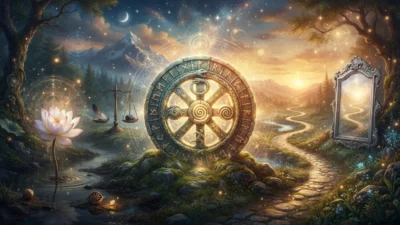
The wheel became another powerful image of changing fortune. The Wheel of Fortune symbolizes the unpredictable rise and fall of circumstances, reminding people that prosperity and hardship can change unexpectedly.
Stars have also been connected with destiny. Astrology developed symbolic systems in which celestial movements were believed to correspond with events or qualities in human life.
Crossroads became associated with important decisions and supernatural encounters in various cultural traditions.
These examples show why fate symbolism remains powerful: humans have always searched for patterns that could explain uncertainty.
Fate Symbolism in Literature and Art
Fate is one of the most important themes in literature.
Tragedies often use prophecy, curses, mysterious predictions, or unavoidable circumstances to create tension. A character may attempt to escape fate only to discover that their actions bring about the very outcome they feared.
This creates dramatic irony and raises questions about free will.
Common symbols of fate in literature and art include:
- Thread: The course of human life
- Wheel: Changing fortune and destiny
- Crossroads: A decisive choice
- Prophecy: Knowledge of a possible future
- Clock: The unstoppable passage of time
- Stars: Cosmic influence or destiny
- Labyrinth: A confusing or predetermined journey
- Road: The unfolding path of life
- Shadow: An unknown future or unavoidable consequence
Artists may use these symbols to show that human beings are caught between freedom and forces they cannot fully understand.
Dream Meaning of Fate Symbolism
Dreams about fate may reflect major life decisions, uncertainty, fear of the future, personal transformation, or a feeling that something important is beyond your control.
The emotional atmosphere of the dream is especially important.
Dreaming About a Crossroads
A crossroads may symbolize an important decision. It can suggest that you are considering different directions in your personal or professional life.
Dreaming About a Thread
A thread may symbolize relationships, life connections, continuity, or a situation that seems to be unfolding according to a larger pattern.
Dreaming About a Wheel
A spinning wheel can represent changing circumstances, repeated life cycles, unexpected fortune, or a sense that events are outside your control.
Dreaming About a Clock
A clock may symbolize urgency, timing, aging, deadlines, or awareness that an important opportunity is passing.
Dreaming About a Path
A road or path may represent your current life direction. A clear path can suggest confidence, while a blocked or confusing path may reflect uncertainty.
Dreaming About a Prophecy
Hearing a prediction in a dream may reflect anxiety about the future or a strong desire for certainty about an important situation.
Dreams are personal, so these interpretations are possibilities rather than fixed predictions.
Modern Meaning of Fate Symbolism
In modern life, fate symbolism often appears in conversations about relationships, career decisions, coincidence, personal growth, and major turning points.
People sometimes describe an unexpected meeting as “meant to happen” or a remarkable coincidence as a sign of destiny.
Romantic stories frequently use fate symbolism through ideas such as soulmates, destined relationships, perfect timing, and chance encounters.
At the same time, modern psychology and philosophy often emphasize personal agency. A person can acknowledge circumstances beyond their control while still recognizing the importance of their choices.
This creates a more balanced interpretation of fate: life may present circumstances, but individuals still decide how to respond to them.
Fate Symbolism and Free Will
Fate and free will are often presented as opposites.
If everything is predetermined, personal choices might seem meaningless. If everything depends entirely on personal decisions, there may appear to be no role for chance, circumstance, or destiny.
Many people find meaning somewhere between these extremes.
A person cannot choose every circumstance they encounter, but they can often choose how they respond. In this sense, fate symbolism may represent the meeting point between circumstance and choice.
The road may already exist, but the traveler still determines how to walk it.
Fate Symbolism in Relationships
Fate symbolism is especially common in romantic relationships.
Two people meeting unexpectedly may describe their relationship as destined or “meant to be.” Symbols such as intertwined threads, matching stars, rings, knots, and crossroads can represent this sense of connection.
However, fate in relationships does not necessarily mean that a relationship will succeed automatically.
A symbolic connection may represent the importance of meeting someone, learning something from the relationship, or experiencing personal growth rather than guaranteeing a permanent outcome.
Is Fate the Same as Destiny?
Fate and destiny are closely related but are not always identical.
Fate often suggests events that are predetermined or unavoidable, while destiny can describe a future path that develops through circumstances, choices, purpose, or personal growth.
Different cultures and philosophical traditions use these words differently.
Frequently Asked Questions About Fate Symbolism
What does fate symbolism mean?
Fate symbolism represents destiny, inevitability, life paths, timing, uncertainty, and forces that may exist beyond human control.
What is the spiritual meaning of fate?
Spiritually, fate can symbolize divine timing, life purpose, spiritual lessons, destiny, synchronicity, or a larger pattern connecting important experiences.
What is the most common symbol of fate?
The thread is one of the most enduring symbols of fate, representing the course of human life. Crossroads, wheels, stars, and clocks are also commonly associated with destiny.
What does dreaming about fate mean?
Dreaming about fate may reflect uncertainty about the future, major decisions, personal transformation, or a feeling that an important situation is outside your control.
Is fate stronger than free will?
There is no universal answer. Many philosophical and religious traditions suggest that circumstances can influence life while personal choices still shape how people respond to them.
Conclusion
Fate symbolism represents one of humanity’s oldest questions: how much of life is determined, and how much can we shape ourselves?
Threads, roads, stars, wheels, clocks, and crossroads remind us that life contains both uncertainty and choice. Whatever someone believes about destiny, fate symbolism can encourage a deeper appreciation of timing, decisions, relationships, and the mysterious turns that make each life unique.
Miles Arthur is a passionate content writer at Symblosim.com, specializing in symbol meanings, cultural symbolism, spiritual interpretations, and historical signs. He creates informative articles that help readers understand the deeper significance of symbols.