Reincarnation symbolism explores the powerful idea of life continuing through cycles of death, rebirth, transformation, and spiritual development. Across different cultures and religious traditions, reincarnation has been used to explain the soul’s journey and the possibility of beginning again.
The symbolism of reincarnation often brings together ideas of rebirth, renewal, karma, the soul, transformation, and spiritual awakening. Whether encountered in religion, mythology, dreams, literature, or modern spirituality, it can represent hope that existence is part of a much larger journey.
Reincarnation Symbolism Meaning (Clear Definition)
Reincarnation symbolism represents the cycle of death and rebirth and the continuation of spiritual existence from one life to another.
The concept appears in several religious and philosophical traditions, although its meaning differs considerably between them. In some traditions, reincarnation involves the continuation of an individual soul. In others, particularly Buddhism, rebirth is understood without an eternal, unchanging soul.
At a symbolic level, reincarnation commonly represents:
| Symbolic Meaning | What It Represents |
|---|---|
| Rebirth | Beginning a new stage of existence |
| Renewal | A fresh opportunity after an ending |
| Transformation | Becoming something different |
| Karma | The consequences of intentional actions |
| Spiritual growth | Learning through repeated existence |
| Continuity | Life continuing beyond one apparent ending |
| Liberation | Freedom from cycles of rebirth |
At its simplest, reincarnation symbolism is about ending, beginning again, and transformation.
What Does Reincarnation Symbolism Represent?
Reincarnation can represent much more than the literal belief in another life.
Rebirth
The strongest symbolic meaning is rebirth. Something ends, but another form of existence begins.
This makes reincarnation a powerful metaphor for personal change. A person may feel that they have left an old identity behind and entered a new chapter.
Renewal
Reincarnation symbolism can suggest that endings are not necessarily final.
A difficult period, relationship, identity, or way of thinking may come to an end, creating room for renewal.
The Soul’s Journey
Many reincarnation traditions describe existence as a journey involving growth, experience, learning, and spiritual development.
The symbolism encourages people to look beyond one moment and consider life as part of a larger process.
Karma and Consequences
Reincarnation is often connected with karma symbolism. In traditions that teach rebirth, actions and intentions can influence future circumstances.
This connection gives reincarnation a strong ethical dimension: how a person lives matters.
Transformation
Reincarnation also represents transformation. Just as a caterpillar changes into a butterfly, the symbolism suggests that existence can move through radically different forms.
Spiritual Meaning of Reincarnation Symbolism
Spiritually, reincarnation symbolism often represents the continuation of growth beyond a single lifetime.
For believers, life may be viewed as one chapter in a much longer spiritual journey. Experiences, relationships, challenges, and choices can become opportunities for learning.
This interpretation can encourage patience and perspective.
Instead of viewing life as a single, isolated event, reincarnation symbolism presents existence as a continuing process of development.
Reincarnation and Spiritual Awakening
Reincarnation is sometimes connected with spiritual awakening because awareness of life’s cycles can encourage deeper questions:
- Who am I beyond my current identity?
- What lessons am I meant to learn?
- Why do certain patterns keep appearing?
- What does personal transformation mean?
- Is there a purpose behind human experience?
These questions do not require a person to accept reincarnation literally. They can also function as tools for self-reflection.
Biblical / Religious Meaning of Reincarnation Symbolism
Reincarnation is not a central teaching of mainstream Christianity, Judaism, or Islam. These traditions generally understand human existence, death, and the afterlife differently from religions that explicitly teach reincarnation or rebirth.
In Hinduism, reincarnation is closely connected with samsara, the cycle of birth, death, and rebirth. Karma influences this cycle, while spiritual liberation, known as moksha, represents freedom from it.
Buddhism also teaches rebirth and samsara, but its explanation differs from Hindu concepts of an enduring soul. Buddhist teachings emphasize dependent arising, karma, and the continuation of causal processes rather than an eternal, permanent self.
Jainism likewise has a strong doctrine of rebirth and karma, with liberation representing release from the cycle.
Because religious interpretations differ, reincarnation should not be treated as a single universal belief.
Reincarnation Symbolism in History and Culture
Beliefs about rebirth have appeared throughout human history.
Ancient Indian philosophical traditions developed sophisticated ideas concerning karma, samsara, rebirth, and liberation. These concepts became central to Hindu, Buddhist, and Jain thought.
Other cultures have also developed stories involving return, renewal, or transformation after death. Ancient Egyptian religion, for example, contained elaborate beliefs about death and the afterlife, although these should not simply be equated with reincarnation.
Across mythology, the recurring pattern is familiar:
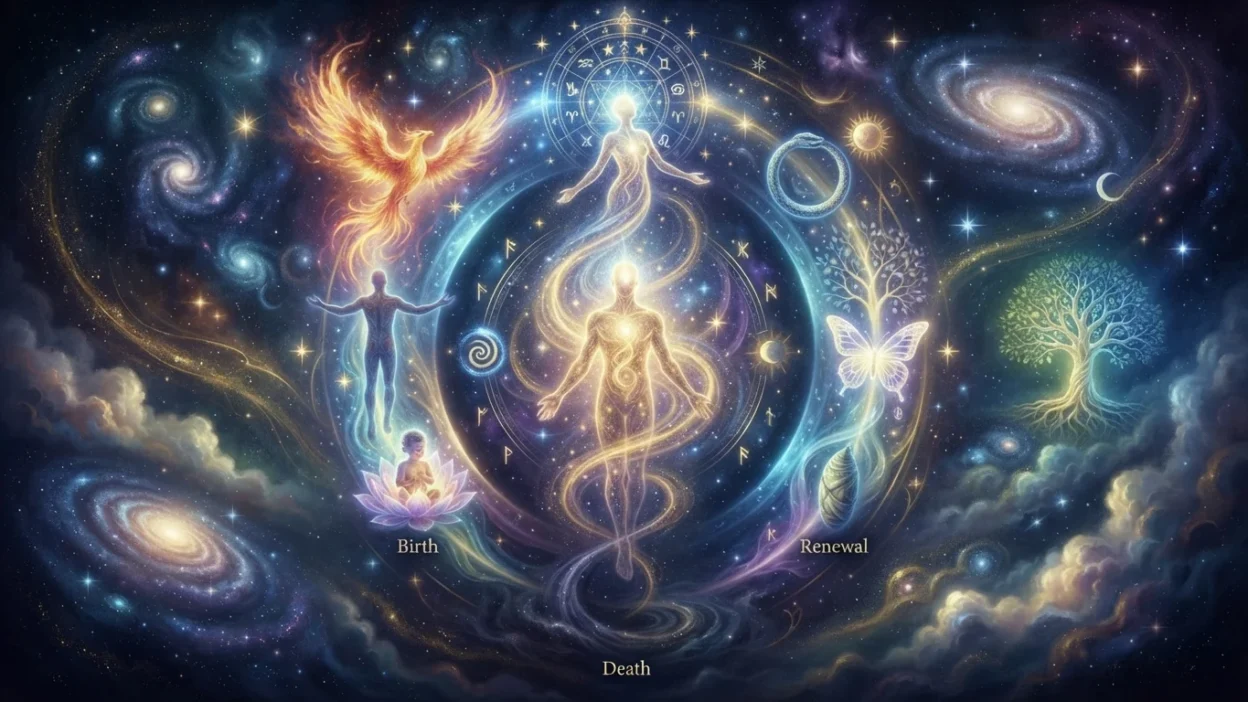
Death → transition → transformation → new existence
This pattern helps explain why reincarnation symbolism continues to resonate across cultures.
Common Reincarnation Symbols
Certain images are frequently associated with rebirth and transformation:
- Butterfly: transformation and renewal
- Phoenix: destruction followed by rebirth
- Lotus: spiritual emergence and renewal
- Snake shedding its skin: transformation and renewal
- Circle or wheel: cycles of existence
- Egg: potential and new life
- Sunrise: beginning again after darkness
These symbols do not all specifically mean reincarnation, but they can communicate related ideas of renewal and transformation.
Reincarnation Symbolism in Literature and Art
Reincarnation has inspired countless stories about identity, memory, destiny, and love.
In literature, a character who returns in another life can create questions about whether personality survives physical death. Writers may use reincarnation to explore whether relationships can transcend time or whether people are destined to repeat certain experiences.
Artists can communicate reincarnation through circular imagery, repeated figures, butterflies, phoenixes, spirals, changing human forms, or scenes showing death transitioning into new life.
The symbolism is particularly effective because it connects two apparently opposite ideas: ending and beginning.
A death scene may therefore represent not only loss but also transformation.
Dream Meaning of Reincarnation Symbolism
Dreaming about reincarnation may symbolize personal transformation, a new beginning, unresolved experiences, or the feeling that an old version of yourself is ending.
A reincarnation dream does not necessarily prove or predict a past life. Dreams often use symbolic stories to process emotions, memories, fears, hopes, and changes.
Possible meanings include:
| Dream Symbol | Possible Interpretation |
|---|---|
| Being reborn | Starting a new chapter |
| Remembering another life | Exploring identity or unresolved feelings |
| Meeting a familiar stranger | A sense of emotional familiarity |
| Dying and returning | Major personal transformation |
| Becoming another person | Changing identity or perspective |
| Repeated life scenes | Recurring patterns or experiences |
| Peaceful rebirth | Acceptance and renewal |
Your emotional reaction within the dream can be especially meaningful.
Feeling peaceful may suggest acceptance of change, while fear may reflect uncertainty about leaving something familiar behind.
Modern Meaning of Reincarnation Symbolism
Today, reincarnation symbolism is often used beyond traditional religious contexts.
Some people interpret it literally as the continuation of consciousness or the soul through multiple lives. Others use reincarnation as a metaphor for personal reinvention.
Someone recovering from a difficult chapter might describe themselves as becoming “a new person.” In this sense, reincarnation becomes a powerful image for psychological and emotional renewal.
Modern spirituality also connects reincarnation with ideas such as:
- Past-life beliefs
- Soul journeys
- Karma
- Spiritual lessons
- Personal transformation
- Consciousness
- Inner awakening
These interpretations vary widely, and they should be distinguished from established religious teachings.
Reincarnation Symbolism and Personal Transformation
One of the most useful ways to understand reincarnation symbolism is as a metaphor for change.
People naturally move through different versions of themselves. Childhood becomes adulthood. Old beliefs are replaced by new perspectives. Relationships begin and end. Careers change. Priorities evolve.
In this sense, a person can experience a symbolic “rebirth” many times during one lifetime.
The message is not necessarily that you must become someone completely different. Instead, it can suggest that growth sometimes requires releasing an identity that no longer fits.
Reincarnation Symbolism in Tattoos and Jewelry
Reincarnation-inspired tattoos and jewelry often represent rebirth, transformation, spiritual continuity, and new beginnings.
Popular imagery includes butterflies, phoenixes, lotus flowers, circles, spirals, ouroboros designs, and symbolic representations of the cycle of life.
A person may choose such imagery after overcoming a difficult period or entering an important new chapter.
The meaning is highly personal. For one person, it may represent a religious belief; for another, it may simply symbolize becoming stronger after change.
Reincarnation Symbolism vs. Rebirth Symbolism
Although these terms overlap, they are not identical.
Reincarnation traditionally refers to the idea that an individual or consciousness continues into another embodied life, depending on the religious framework.
Rebirth is broader. It can describe spiritual renewal, transformation, or the beginning of a new existence without necessarily implying an eternal individual soul.
This distinction is especially important when discussing Buddhism, where rebirth is generally preferred to the idea of reincarnation involving a permanent soul.
FAQs About Reincarnation Symbolism
What does reincarnation symbolism mean?
Reincarnation symbolism represents death, rebirth, renewal, transformation, and the continuation of spiritual existence. It can also symbolize starting over after a major life change.
What does reincarnation symbolize spiritually?
Spiritually, reincarnation can symbolize the soul’s journey, karmic consequences, spiritual lessons, and liberation from repeated cycles of existence. Its precise meaning depends on the religious tradition.
What symbols represent reincarnation?
Common symbols associated with reincarnation include butterflies, phoenixes, lotus flowers, circles, spirals, snakes shedding their skin, and the Wheel of Life. These images generally represent rebirth, transformation, or cyclical existence.
What does dreaming about reincarnation mean?
A reincarnation dream may symbolize personal transformation, a new beginning, recurring life patterns, or changes in identity. Its meaning depends on the dream’s details and your emotions during it.
Is reincarnation mentioned in the Bible?
Mainstream Christianity does not teach reincarnation as a central doctrine. Biblical teachings about death, resurrection, judgment, and eternal life differ significantly from traditional reincarnation beliefs.
Conclusion
Reincarnation symbolism is ultimately a symbol of endings that lead to new beginnings. Whether understood through religion, mythology, art, dreams, or personal transformation, it reminds us that change can be part of a larger journey.
Its deepest message is hopeful: an ending does not always mean that the story is over. Sometimes, it marks the beginning of a new form of growth.
Miles Arthur is a passionate content writer at Symblosim.com, specializing in symbol meanings, cultural symbolism, spiritual interpretations, and historical signs. He creates informative articles that help readers understand the deeper significance of symbols.