
Meditation symbolism represents inner peace, self-awareness, spiritual growth, mental clarity, and the journey toward a deeper understanding of oneself. Across cultures and traditions, meditation has been associated with stillness, wisdom, discipline, healing, and connection with something greater than the individual self.
Meditation is more than simply sitting quietly. Symbolically, it can represent stepping away from external distractions and turning inward. The images, objects, postures, and experiences connected with meditation often carry meanings related to transformation and personal awakening.
Whether you encounter meditation in religious traditions, artwork, dreams, literature, or everyday life, its symbolism usually points toward reflection, balance, awareness, and inner transformation.
Meditation Symbolism Meaning (Clear Definition)
Meditation symbolism is the use of meditation, meditative postures, peaceful settings, and related imagery to represent inner stillness, awareness, spiritual reflection, and personal transformation.
At its simplest, meditation symbolizes the movement from external noise toward internal clarity. It suggests creating space to observe thoughts and emotions without immediately reacting to them.
The symbolic meaning of meditation can include:
| Symbolic ElementCommon Meaning | |
|---|---|
| Stillness | Peace, patience, and emotional balance |
| Closed eyes | Introspection and turning inward |
| Lotus posture | Spiritual growth and awakening |
| Silence | Inner listening and contemplation |
| Breath | Life, awareness, and presence |
| Candle or flame | Focus, wisdom, and illumination |
| Mountain meditation | Stability, strength, and endurance |
| Water | Emotional cleansing and clarity |
| Light | Knowledge, consciousness, and spiritual insight |
Because meditation appears in many traditions, its meaning can change according to cultural and personal context.
For one person, meditation may symbolize religious devotion. For another, it may represent mindfulness, emotional balance, self-discovery, or simply the need to slow down.
What Does Meditation Symbolism Represent?
Meditation symbolism commonly represents peace, awareness, discipline, spiritual awakening, balance, and self-discovery.
1. Inner Peace
One of the strongest meanings associated with meditation is inner peace.
The quiet posture of a person meditating often contrasts with the movement and noise of the outside world. Symbolically, this contrast suggests that peace does not always depend on external circumstances.
Instead, peace can come from developing a calmer relationship with one’s thoughts and emotions.
2. Self-Awareness
Meditation encourages observation rather than immediate reaction. For this reason, it often symbolizes becoming more conscious of one’s inner world.
In symbolic imagery, a meditating person may represent someone who is searching for answers within rather than relying entirely on external influences.
3. Spiritual Awakening
Meditation is frequently associated with spiritual awakening. The journey inward can symbolize a gradual realization of deeper truths about existence, identity, consciousness, or purpose.
This symbolism is particularly strong when meditation is portrayed alongside light, stars, sacred geometry, temples, or other spiritual imagery.
4. Discipline and Patience
Meditation may look passive, but maintaining a regular practice requires discipline.
Symbolically, this makes meditation a representation of patience and consistent personal effort. It can suggest that meaningful transformation develops gradually rather than instantly.
5. Balance
A calm and centered meditation posture can symbolize harmony between different parts of life.
This may include balancing thought and emotion, action and rest, individuality and community, or material concerns and spiritual values.
6. Transformation
Meditation can also represent personal transformation.
The symbolic journey often begins with confusion or distraction and moves toward greater awareness. In this sense, meditation represents a process of becoming rather than a fixed state of being.
Related symbolic ideas include: mindfulness symbolism, inner peace symbolism, spiritual awakening, self-awareness, enlightenment, contemplation, and personal transformation.
Spiritual Meaning of Meditation Symbolism
The spiritual meaning of meditation symbolism is closely connected with inner awakening, consciousness, connection, reflection, and the search for deeper truth.
In spiritual contexts, meditation can symbolize creating an intentional space between the individual and the distractions of ordinary life.
This does not necessarily mean escaping reality. Instead, it can represent seeing reality more clearly.
Meditation as Inner Journey
Many spiritual traditions describe growth as an inward journey. Meditation naturally fits this symbolism because the practitioner directs attention toward the mind, breath, body, or chosen object of contemplation.
The physical stillness becomes a metaphor for an internal journey.
Meditation and Enlightenment
Meditation is also commonly associated with enlightenment.
In symbolic language, enlightenment is often represented through light. A person emerging from darkness into light can represent movement from ignorance toward understanding.
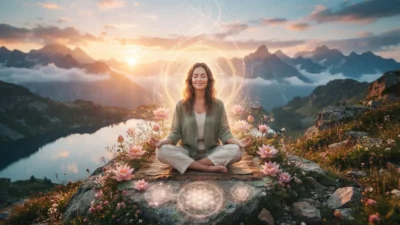
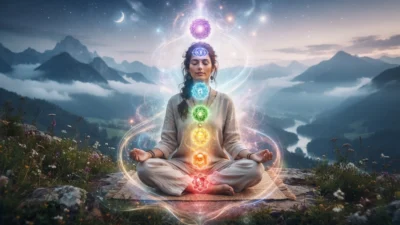
For this reason, meditating figures surrounded by a glow or luminous aura frequently symbolize expanded awareness.
Meditation and Connection
Meditation may symbolize a connection with the divine, nature, universal consciousness, or one’s deepest sense of self, depending on the tradition.
The meaning is therefore not identical for everyone. Its interpretation depends heavily on spiritual beliefs and personal experience.
Meditation and Detachment
Another important spiritual theme is detachment.
Meditation can symbolize learning to observe thoughts without becoming completely controlled by them. Symbolically, this represents freedom from excessive attachment, fear, distraction, or emotional reactivity.
Biblical / Religious Meaning of Meditation Symbolism
Meditation has religious significance in several traditions, although its practices and interpretations differ considerably.
In the Bible, meditation is often associated with thoughtful reflection on God’s teachings, laws, works, and character. Biblical meditation is therefore not necessarily identical to every modern form of mindfulness or contemplative practice.
Psalm 1:2, for example, describes the righteous person as one who meditates on God’s law day and night. Joshua 1:8 similarly connects meditation on God’s law with faithful living and careful observance.
These references give meditation a symbolic meaning of reflection, devotion, wisdom, obedience, and spiritual focus.
In Christianity, contemplative practices have also developed around prayer, silence, scripture, and reflection. Meditation imagery can therefore symbolize a person’s desire to deepen their relationship with God.
Other religious traditions have their own distinctive meanings.
These traditions should not be treated as interchangeable. Each has its own philosophical and religious context.
Meditation Symbolism in History and Culture
Meditation has a long history across Asia and has influenced religious practice, philosophy, visual art, literature, and modern wellness culture.
Ancient traditions developed different approaches to contemplation, concentration, breath awareness, prayer, and spiritual discipline.
Over centuries, meditative practices became associated with teachers, monks, sages, temples, sacred landscapes, and philosophical schools.
The Lotus and Meditation
The lotus is one of the most recognizable symbols associated with meditation.
Because the lotus grows from muddy water while producing a beautiful flower above the surface, it can symbolize spiritual growth emerging from difficult or imperfect circumstances.
The lotus therefore complements meditation symbolism particularly well. It suggests that inner clarity can develop even when life feels complicated.
The Meditating Sage
Images of sages, monks, and spiritual teachers sitting in meditation often represent wisdom and mastery of the mind.
The figure’s stillness can symbolize knowledge that comes not from constant activity but from observation and contemplation.
Nature and Meditation
Mountains, forests, rivers, caves, and gardens frequently appear in meditation imagery.
These settings symbolize retreat, simplicity, stability, and closeness to nature.
A mountain is particularly powerful because it can represent endurance and steadiness. A meditating person positioned like a mountain suggests remaining grounded despite changing circumstances.
Meditation Symbolism in Literature and Art
Artists and writers have long used meditation to symbolize reflection, isolation, wisdom, mystery, and transformation.
A character sitting alone in silence may represent a turning point in a story. Their physical stillness can signal that an important internal change is taking place.
Meditation in Visual Art
Meditating figures are often portrayed with symmetrical compositions, calm facial expressions, balanced postures, natural surroundings, or luminous backgrounds.
These artistic choices reinforce themes of harmony and transcendence.
The surrounding environment also affects interpretation.
A meditation scene in a peaceful garden may symbolize healing and serenity, while a lone figure meditating in a dark room could suggest grief, self-examination, or searching for answers.
Meditation as a Literary Symbol
In literature, meditation can represent a character’s internal dialogue without requiring dramatic external action.
It may symbolize:
- A search for truth
- Emotional healing
- Personal awakening
- Withdrawal from conflict
- Moral reflection
- Acceptance
- Preparation for change
A meditative moment can therefore serve as a bridge between a character’s old identity and a new understanding of life.
Dream Meaning of Meditation Symbolism
Dreams involving meditation often symbolize a desire for peace, clarity, emotional balance, or deeper self-understanding.
The exact meaning depends on the dreamer’s circumstances and emotions.
Dreaming of Meditating Peacefully
If you dream about meditating peacefully, it may represent a desire to escape stress or restore emotional balance.
It can also suggest that your mind is searching for greater clarity.
Dreaming of Struggling to Meditate
Difficulty staying still or concentrating during meditation may symbolize mental overload, unresolved emotions, anxiety, or competing responsibilities.
The dream may reflect a need to slow down rather than a literal message about meditation itself.
Dreaming of Meditating in Nature
Meditating beside a river, mountain, forest, or ocean may symbolize emotional healing, stability, freedom, or reconnection with yourself.
Natural surroundings often strengthen the symbolism of renewal and balance.
Dreaming of a Meditating Person
Seeing another person meditating can symbolize wisdom, calmness, guidance, or qualities you wish to develop.
Sometimes the person may represent an aspect of yourself that feels peaceful or emotionally centered.
Dream symbolism is highly personal, so these interpretations should be viewed as possibilities rather than fixed predictions.
Modern Meaning of Meditation Symbolism
In modern culture, meditation symbolism extends beyond traditional religion.
Today, meditation is often associated with mindfulness, stress management, emotional wellness, self-care, productivity, and mental clarity.
Meditating figures appear in wellness applications, fitness programs, personal development content, home décor, books, advertising, and social media.
The symbolism has consequently become more accessible and diverse.
Meditation as Self-Care
Modern meditation imagery often communicates the idea of taking time for oneself.
A person sitting quietly with closed eyes may symbolize a deliberate pause from work, technology, social demands, and everyday pressure.
Meditation as Mental Clarity
The modern symbolic meaning also emphasizes a clear mind.
Images of calm people surrounded by minimal spaces, soft natural settings, or uncluttered environments communicate simplicity and focus.
Meditation as Personal Growth
Meditation is increasingly portrayed as part of a larger journey of self-improvement.
In this context, it symbolizes becoming more intentional, emotionally aware, patient, and present.
However, modern representations can sometimes simplify traditions that have much deeper religious and philosophical histories. Understanding the original context can make the symbolism more meaningful.
Common Meditation Symbols and Their Meanings
Certain images frequently appear alongside meditation symbolism.
- Lotus: spiritual growth, purity, awakening, and resilience
- Candle flame: concentration, wisdom, illumination, and awareness
- Closed eyes: introspection and inward attention
- Breath: life, presence, rhythm, and consciousness
- Mountain: stability, endurance, and groundedness
- Water: emotional clarity, cleansing, and renewal
- Sunrise: awakening, hope, and a new beginning
- Moon: reflection, intuition, mystery, and inner awareness
- Silence: contemplation, peace, and listening inwardly
- Circle: wholeness, unity, balance, and continuity
These symbols can overlap, and their meanings can change according to culture, religion, artwork, or personal experience.
Why Is Meditation a Powerful Symbol?
Meditation is powerful as a symbol because it represents something almost everyone can understand: the need to pause and look inward.
Its visual simplicity also gives it broad symbolic potential.
A single seated figure can communicate peace, wisdom, isolation, discipline, spiritual searching, or transformation without words.
Meditation also represents a paradox. The body may appear completely still while the inner world is undergoing significant activity.
That contrast makes meditation particularly meaningful in art, literature, spirituality, and personal symbolism.
Is Meditation Symbolism Always Spiritual?
No. Meditation symbolism can be spiritual, religious, psychological, emotional, philosophical, or secular.
For some people, meditation represents prayer or spiritual connection. For others, it represents mindfulness, concentration, relaxation, emotional regulation, or simply creating a quiet moment during a busy day.
The surrounding context usually determines the most appropriate interpretation.
Frequently Asked Questions About Meditation Symbolism
What does meditation symbolize?
Meditation commonly symbolizes inner peace, self-awareness, spiritual growth, mindfulness, balance, and personal transformation.
What does a meditating person symbolize?
A meditating person often symbolizes calmness, wisdom, discipline, introspection, and the search for deeper understanding.
What does the lotus symbolize in meditation?
The lotus commonly symbolizes spiritual awakening, resilience, purity, and growth emerging from difficult circumstances.
What is the spiritual meaning of meditation?
Spiritually, meditation can represent inner awakening, contemplation, connection with the divine or deeper self, and movement toward greater awareness.
What does meditation mean in dreams?
Dreaming about meditation may symbolize a need for peace, clarity, emotional balance, self-reflection, or relief from mental pressure.
Conclusion
Meditation symbolism ultimately points toward the quiet power of turning inward. Whether it represents spiritual awakening, inner peace, wisdom, mindfulness, or personal transformation, meditation reminds us that stillness can be meaningful.
Its deepest symbol may be simple: when the outside world becomes noisy, looking within can reveal a different kind of clarity.

Miles Arthur is a passionate content writer at Symblosim.com, specializing in symbol meanings, cultural symbolism, spiritual interpretations, and historical signs. He creates informative articles that help readers understand the deeper significance of symbols.