Yoga symbolism represents unity, balance, inner peace, spiritual growth, self-awareness, and the connection between body, mind, and deeper consciousness. Although yoga is often associated with physical postures today, its symbolism reaches far beyond exercise.
For centuries, yoga has been connected with discipline, contemplation, breath, meditation, ethical living, and the search for greater awareness. Its symbols, poses, gestures, and visual imagery can communicate ideas about transformation and harmony.
Whether you encounter yoga symbolism in spirituality, art, dreams, literature, or modern wellness culture, it often points toward one central idea: creating greater harmony within oneself.
Yoga Symbolism Meaning (Clear Definition)
Yoga symbolism is the symbolic meaning associated with yoga practices, postures, breathing, meditation, sacred imagery, and philosophical ideas.
The word yoga comes from the Sanskrit root yuj, commonly associated with joining, yoking, or union. This idea of connection provides an important foundation for understanding yoga symbolism.
Yoga can symbolically represent the union of:
- Body and mind
- Breath and awareness
- Individual and universal consciousness
- Strength and flexibility
- Effort and surrender
- Physical life and spiritual development
- Inner self and outer world
The meaning of yoga symbolism varies according to tradition. A yoga pose may have a physical purpose while also carrying metaphorical or spiritual associations.
What Does Yoga Symbolism Represent?
Yoga symbolism commonly represents balance, unity, discipline, transformation, mindfulness, strength, flexibility, and spiritual awareness.
1. Unity and Connection
The idea of union is central to yoga symbolism.
Yoga can represent bringing different aspects of life into greater harmony. Rather than viewing the body, mind, emotions, and spirit as completely separate, yoga traditions often explore their relationship.
2. Balance
Many yoga poses require stability and concentration.
For this reason, yoga postures can symbolize emotional and spiritual balance. Standing poses may represent grounding, while balancing poses can suggest patience, focus, and inner stability.
3. Flexibility
Physical flexibility has an obvious role in yoga, but symbolically it can represent adaptability.
A flexible body can become a metaphor for a flexible mind: the ability to adjust, learn, accept change, and move through difficult circumstances without losing one’s center.
4. Strength
Yoga symbolism is not only about relaxation.
Many poses require physical endurance and mental determination. Strength in this context can represent resilience, courage, discipline, and the ability to remain steady during challenges.
5. Inner Transformation
Yoga is often portrayed as a journey.
A person begins with limitations, develops awareness through practice, and gradually discovers greater control and understanding. Symbolically, this makes yoga an image of personal transformation.
6. Mindfulness
Yoga encourages attention to the body, breath, movement, and present experience.
Its symbolism therefore includes mindfulness and conscious living. Instead of constantly looking toward the past or future, yoga can represent learning to become more fully present.
Related symbolic concepts include: yoga spirituality, yoga poses meaning, lotus symbolism, chakra symbolism, meditation symbolism, mindfulness, and inner balance.
Spiritual Meaning of Yoga Symbolism
The spiritual meaning of yoga symbolism is closely connected with self-knowledge, consciousness, discipline, union, liberation, and spiritual awakening.
Traditional yoga philosophy is much broader than physical exercise. Different schools and texts have explored meditation, ethical conduct, breath practices, concentration, contemplation, and liberation.
Yoga as a Spiritual Journey
Yoga can symbolize a journey from ordinary awareness toward deeper understanding.
The journey is often inward. Instead of searching only for fulfillment through external achievements, the practitioner explores consciousness, habits, emotions, and identity.
Yoga and Self-Discovery
Yoga symbolism can represent the process of discovering who you are beneath temporary emotions and social roles.
The quiet attention developed through practice can symbolize looking beyond surface-level identity.
Yoga and Spiritual Awakening
In some traditions, yoga is connected with spiritual awakening and expanded consciousness.
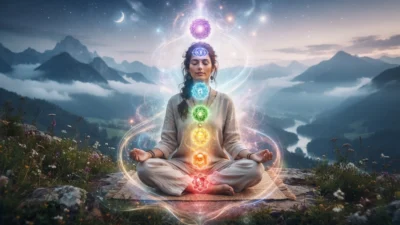
Images involving light, chakras, lotus flowers, meditation, or rising energy may symbolize this awakening.
These ideas belong to particular spiritual traditions and should not be treated as universal descriptions of every modern yoga practice.
Yoga and Liberation
Some classical yoga philosophies understand the ultimate goal as liberation from ignorance and the cycles of suffering.
In this context, yoga symbolizes freedom, wisdom, detachment, and a deeper realization of the nature of consciousness.
Biblical / Religious Meaning of Yoga Symbolism
Yoga does not originate in the Bible or Christian tradition, so there is no direct biblical symbolism of yoga comparable to specifically biblical symbols.
Yoga developed within the religious and philosophical traditions of South Asia, particularly within Hindu traditions, while related contemplative practices and ideas also developed in Buddhism, Jainism, and other cultural contexts.
From a comparative religious perspective, some themes associated with yoga may resemble broader religious concepts such as discipline, contemplation, self-control, humility, prayer, and spiritual reflection. However, these similarities do not mean that yoga and biblical spirituality have identical beliefs or practices.
For this reason, it is useful to distinguish yoga’s historical religious symbolism from modern interpretations that use yoga primarily for physical fitness, relaxation, or mindfulness.
Yoga in Hindu Traditions
Yoga has deep connections with Hindu philosophy and religious literature.
Different paths of yoga have emphasized action, devotion, knowledge, meditation, and disciplined practice. The Bhagavad Gita, for example, discusses several forms of yoga as paths of spiritual development.
Yoga in Buddhism and Jainism
Meditative and disciplined practices associated with yoga-like traditions have also interacted historically with Buddhist and Jain traditions.
The details differ considerably between traditions, but themes such as mindfulness, self-discipline, contemplation, and liberation appear in various forms.
Yoga Symbolism in History and Culture
Yoga has a long and complex history in South Asia.
Its development cannot be reduced to a single practice or philosophy. Over time, different teachers, texts, philosophical schools, and religious communities contributed to the evolution of yogic traditions.
Ancient and medieval sources discuss practices involving meditation, breath control, ethical discipline, concentration, and physical techniques.
The lotus itself has deep symbolic associations in South Asian traditions. Because it emerges from muddy water while producing a striking flower, it can represent purity, spiritual development, resilience, and awakening.
The lotus posture therefore became a powerful visual symbol of meditation and contemplation.
The Om Symbol
The sacred syllable Om is another widely recognized symbol connected with Hindu traditions and yoga.
It is associated with sacred sound, consciousness, and spiritual reality in particular philosophical and religious contexts.
Today, the Om symbol is frequently used in yoga studios, jewelry, clothing, artwork, and meditation spaces. Its modern popularity, however, exists alongside its deeper religious significance.
Chakras
Chakra imagery is also strongly associated with contemporary yoga and spirituality.
The chakra system has developed through particular Indian religious and philosophical traditions. Modern representations often depict a series of energy centers along the body, each associated with different qualities and colors.
In popular culture, chakra symbolism frequently represents emotional balance, energy, healing, and self-awareness.
Yoga Symbolism in Literature and Art
Yoga has provided artists and writers with powerful imagery for exploring inner transformation.
A meditating or practicing figure can symbolize discipline, wisdom, solitude, spiritual searching, or freedom from worldly distraction.
Yoga in Visual Art
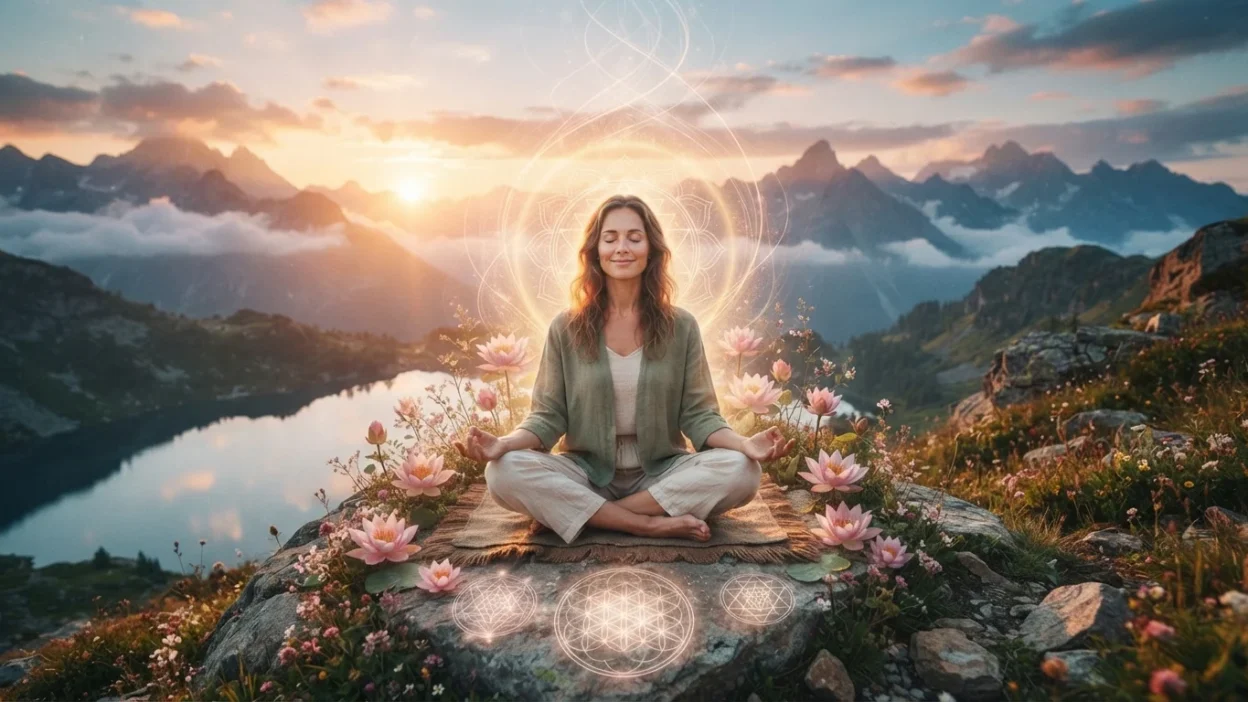
Yoga-inspired artwork commonly features:
- Lotus flowers
- Meditating figures
- Sacred geometry
- Mountains
- Sunrises and sunsets
- Chakras
- Om imagery
- Flowing energy
- Natural landscapes
These elements can create a visual language of peace and spiritual awareness.
Yoga in Literature
In literature, yoga may symbolize a character’s search for identity or meaning.
A character who leaves a busy life to pursue contemplation may represent a desire to escape superficial values and discover a deeper purpose.
Yoga can also symbolize patience and transformation because meaningful progress often requires repeated effort.
Dream Meaning of Yoga Symbolism
Dreams involving yoga may symbolize balance, healing, self-discovery, flexibility, emotional control, or the need for greater peace.
The interpretation depends strongly on the dreamer’s emotions and circumstances.
Dreaming of Practicing Yoga
Dreaming about practicing yoga may suggest that you are seeking balance or trying to regain control over a stressful area of life.
It can also represent a desire for greater self-awareness.
Dreaming of Difficult Yoga Poses
Struggling with a yoga pose may symbolize difficulties with balance, adaptability, confidence, or control.
The dream may reflect a real-life situation in which you feel challenged but are still learning.
Dreaming of Perfectly Balanced Yoga
Successfully holding a difficult pose may represent confidence, stability, patience, or a growing sense of personal control.
Dreaming of a Lotus Pose
A lotus position in a dream may symbolize peace, reflection, spiritual curiosity, or the desire to slow down.
Dream interpretation is personal, so these meanings should be viewed as possibilities rather than fixed predictions.
Modern Meaning of Yoga Symbolism
In modern society, yoga symbolism has expanded beyond its traditional religious and philosophical contexts.
Today, yoga is commonly associated with wellness, mindfulness, flexibility, physical strength, relaxation, self-care, and stress reduction.
A person practicing yoga on a beach, in a studio, or in nature may symbolize a desire for a healthier and more balanced lifestyle.
Yoga as Self-Care
Modern yoga imagery frequently communicates the importance of taking time for oneself.
The practice can symbolize creating a pause from busy schedules and reconnecting with the body.
Yoga as Emotional Balance
Yoga is also widely portrayed as a tool for cultivating calmness and awareness.
This gives it a modern symbolic meaning connected with managing stress, becoming more present, and developing a healthier relationship with one’s emotions.
Yoga as Personal Empowerment
Strong yoga poses can symbolize confidence and resilience.
The physical body becomes a visual representation of inner strength, suggesting that confidence can develop through patience, practice, and self-awareness.
Yoga and Nature
Modern yoga photography often places practitioners in forests, mountains, beaches, and gardens.
These settings strengthen themes of harmony, freedom, grounding, renewal, and connection with nature.
Common Yoga Symbols and Their Meanings
| Yoga Symbol | Common Symbolic Meaning |
|---|---|
| Lotus | Purity, growth, resilience, spiritual awakening |
| Om | Sacred sound, consciousness, spiritual reality |
| Yoga mat | Practice, discipline, personal journey |
| Meditation posture | Stillness, reflection, awareness |
| Chakra | Energy, consciousness, balance |
| Mountain pose | Grounding, stability, strength |
| Tree pose | Balance, growth, rootedness |
| Breath | Life, presence, connection |
| Sun | Vitality, awakening, renewal |
| Mandala | Wholeness, harmony, contemplation |
These meanings are broad interpretations. A symbol can have different meanings depending on the tradition, artwork, practitioner, and cultural setting.
Why Is Yoga a Powerful Symbol?
Yoga is a powerful symbol because it combines physical movement with ideas of inner development.
A single posture can communicate strength and calmness at the same time. A balanced pose can represent stability, while controlled breathing can symbolize the relationship between body and mind.
Yoga also represents progress.
You do not need to master everything immediately. The practice itself becomes symbolic of patience, consistency, acceptance, and growth.
Is Yoga Symbolism Always Religious?
No. Yoga symbolism can have religious, spiritual, philosophical, psychological, cultural, or secular meanings.
For some people, yoga is part of a spiritual or religious tradition. For others, it is primarily a physical practice or a form of mindfulness and relaxation.
Understanding the historical context helps prevent modern interpretations from being confused with the beliefs of specific traditions.
Frequently Asked Questions About Yoga Symbolism
What does yoga symbolize?
Yoga commonly symbolizes unity, balance, mindfulness, discipline, self-awareness, spiritual growth, and transformation.
What does the lotus symbolize in yoga?
The lotus often symbolizes spiritual growth, resilience, purity, and awakening because it rises from muddy water and blooms above it.
What does Om symbolize in yoga?
Om is a sacred symbol and sound associated with spiritual reality and consciousness within Hindu traditions and related practices.
What does yoga symbolize spiritually?
Spiritually, yoga can symbolize self-discovery, disciplined awareness, union, liberation, contemplation, and a journey toward deeper consciousness.
What does yoga mean in dreams?
Yoga in dreams may symbolize a desire for balance, emotional healing, flexibility, self-control, or greater inner peace.
Conclusion
Yoga symbolism is ultimately about harmony—the meeting point between body, mind, breath, awareness, and personal growth. From the lotus and Om to balancing poses and meditative stillness, its symbols communicate ideas of transformation and inner connection.
Whether understood through traditional philosophy or modern wellness culture, yoga reminds us that meaningful change often begins with becoming more aware of ourselves.

Miles Arthur is a passionate content writer at Symblosim.com, specializing in symbol meanings, cultural symbolism, spiritual interpretations, and historical signs. He creates informative articles that help readers understand the deeper significance of symbols.