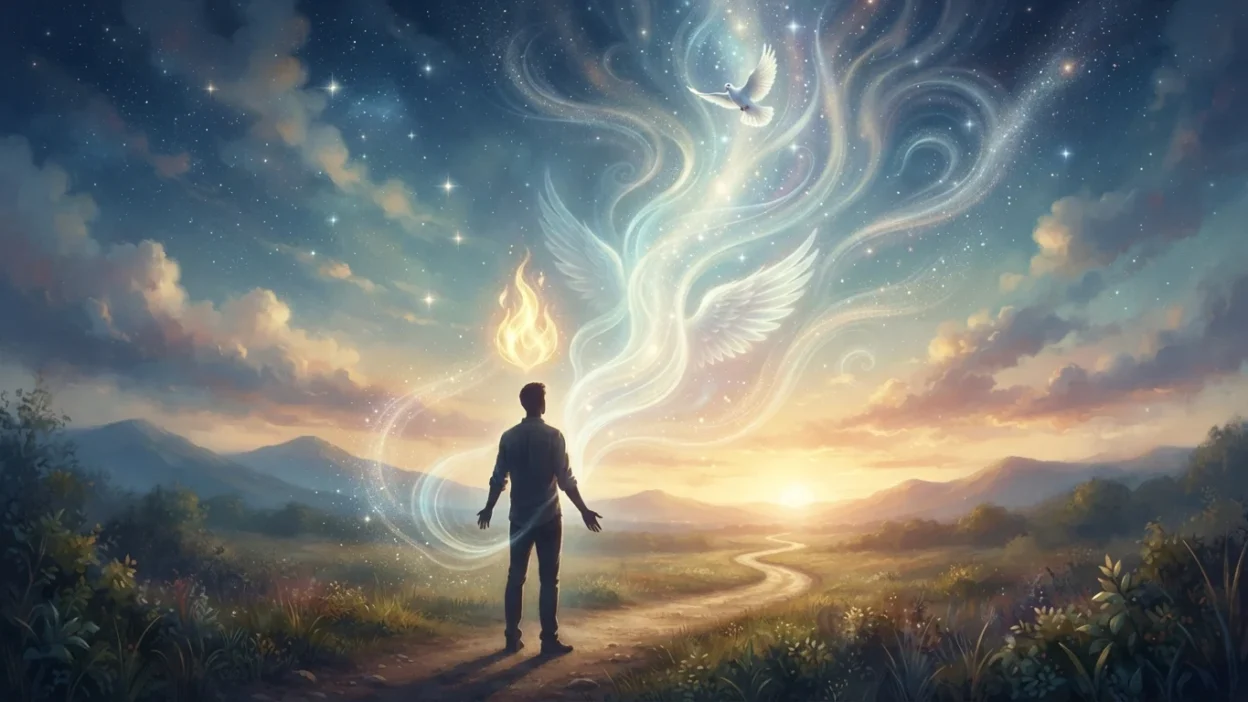
Spirit symbolism explores the idea of an invisible force or presence connected with life, consciousness, identity, energy, and the unseen world. Across religions and cultures, the spirit is often understood as something deeper than the physical body.
The word “spirit” can have many meanings. It may refer to a person’s inner nature, a life-giving force, a sacred presence, a supernatural being, or the emotional energy that shapes a person or community. Because of this, spirit symbolism can be both deeply personal and culturally diverse.
Understanding spirit symbolism can help explain religious traditions, myths, dreams, literature, artwork, and everyday expressions. It can also provide a meaningful way to explore ideas such as spiritual energy, inner strength, freedom, transformation, and connection.
Spirit Symbolism Meaning (Clear Definition)
Spirit symbolism refers to the use of spirit as a representation of life energy, consciousness, inner identity, spirituality, freedom, and connection with the unseen or sacred.
Unlike the physical body, the spirit is usually associated with something invisible. It may symbolize what gives life meaning or what makes an individual feel alive and connected to something beyond material existence.
Common meanings of spirit symbolism include:
- Life force
- Spiritual energy
- Inner self
- Consciousness
- Freedom
- Courage
- Inspiration
- Divine connection
- Transformation
- Guidance
- Hope
- The unseen world
The meaning changes according to context. A peaceful spirit may represent harmony, while a restless spirit may symbolize unresolved emotions or an unsettled existence.
Spirit and Soul: Are They the Same?
The words spirit and soul are sometimes used interchangeably, but they can have different meanings.
The soul is often described as a person’s deepest essence or identity. Spirit may emphasize life energy, divine connection, consciousness, or a person’s relationship with the unseen world.
Religious and philosophical traditions differ considerably in how they define both concepts.
What Does Spirit Symbolism Represent?
Spirit symbolism can represent many aspects of human experience. Its most common meanings involve life, freedom, identity, energy, and spiritual connection.
Life and Vitality
Spirit is frequently associated with the force that makes something alive.
Expressions such as “full of spirit” suggest energy, enthusiasm, and vitality. In this sense, spirit symbolizes the active force within a living person.
Inner Identity
Spirit can represent a person’s deeper character.
Someone with a “strong spirit” may be seen as courageous, determined, or resilient. Someone with a “gentle spirit” may be associated with kindness and compassion.
Freedom
Spirit is often connected with freedom because it is imagined as something that cannot easily be physically contained.
Birds, wind, open skies, and floating lights can therefore become symbolic representations of a free spirit.
Courage and Resilience
A strong spirit can symbolize the ability to continue through difficult experiences.
Spirit symbolism in this context represents determination, hope, endurance, and the refusal to surrender.
Inspiration
The word “spirit” is also closely related to inspiration.
A person may feel spiritually inspired by nature, music, art, faith, or another person’s kindness. The spirit can therefore symbolize the invisible source of motivation and creativity.
Connection With the Unseen
Spirit symbolism often points toward realities that cannot be physically observed.
This may include God, ancestors, supernatural beings, universal energy, or a person’s inner consciousness, depending on the belief system.
Spiritual Meaning of Spirit Symbolism
Spirit symbolism has a particularly strong connection with spiritual awareness and the search for meaning.
In many traditions, the spirit represents the part of existence that connects the individual with something greater than the physical world.
Spirit symbolism may therefore suggest:
- Spiritual awakening
- Divine connection
- Inner guidance
- Peace
- Faith
- Higher purpose
- Personal transformation
- Intuition
- Compassion
- Transcendence
Spirit as Inner Guidance
A person’s spirit is sometimes described as an inner guide.
In symbolic language, following your spirit can mean listening to your deepest values, intuition, or sense of purpose.
This interpretation encourages people to look beyond immediate circumstances and consider what feels meaningful at a deeper level.
Spirit and Spiritual Awakening
A spiritual awakening may be symbolized by light, rising energy, open skies, or a journey from darkness into brightness.
The underlying idea is transformation: becoming more aware of oneself, one’s values, and one’s connection to the world.
Spirit as a Source of Peace
A peaceful spirit often symbolizes emotional balance and acceptance.
It may represent a state in which a person feels connected, grounded, and less controlled by fear or inner conflict.
Biblical / Religious Meaning of Spirit Symbolism
The concept of spirit appears throughout many religious traditions, although its meaning differs between them.
In the Bible, words translated as “spirit” can refer to breath, wind, life, inner disposition, or the divine Spirit, depending on the context. In Christianity, the Holy Spirit has a central theological role and is associated with God’s presence and activity.
Spirit in Christianity
Christianity gives particular importance to the Holy Spirit, understood as the presence and power of God.
The spirit can also refer to the inner life of a person. Spiritual transformation, faith, prayer, wisdom, and moral character are therefore closely connected with ideas of spirit.
Spirit symbolism in Christian imagery may include:
- Dove
- Breath
- Wind
- Fire
- Light
- Oil
- Water
These symbols can communicate ideas such as divine presence, renewal, purification, guidance, and spiritual power.
Spirit in Judaism
Jewish traditions contain rich ideas about spirit, breath, life, and God’s presence.
The Hebrew word ruach can carry meanings related to wind, breath, and spirit. This connection creates a powerful symbolic relationship between physical breath, life, movement, and the unseen.
Spirit in Islam
Islamic teachings distinguish between concepts such as the ruh and the human self or soul, with detailed interpretations varying among theological traditions.
The spirit can be discussed in relation to life, divine creation, human responsibility, and the mystery of existence.
Spirit in Hindu Traditions
Hindu philosophies contain several concepts concerning the self, consciousness, and spiritual reality.
Ideas such as atman and Brahman are especially important in Hindu philosophical traditions, although their interpretations differ among schools.
Spirit in Indigenous and Traditional Beliefs
Many Indigenous and traditional cultures have developed rich understandings of spirit in relation to ancestors, nature, animals, places, dreams, and community.
These traditions should not be treated as one single belief system. Their meanings vary greatly from culture to culture.
Spirit Symbolism in History and Culture
Throughout history, people have used spirit symbolism to explain life, death, nature, dreams, and experiences that seemed beyond ordinary physical understanding.
Ancient cultures often connected breath and wind with life because both are invisible but observable through their effects.
Wind as a Symbol of Spirit
Wind is one of the oldest symbols associated with spirit.
You cannot see wind directly, but you can see what it moves. This makes it a powerful metaphor for invisible spiritual forces.
A gentle breeze may symbolize peace or guidance, while a powerful wind may suggest transformation, divine power, or sudden change.
Fire as a Spirit Symbol
Fire often represents energy, purification, passion, and transformation.
Because fire gives warmth and light while also possessing destructive power, it can symbolize both creation and change.
Bird Symbolism
Birds are frequently associated with spirit because they move between earth and sky.
They can represent:
- Freedom
- Ascension
- Hope
- Transcendence
- Messages
- The journey of the spirit
The exact interpretation depends on the bird and cultural context.
Light as a Spiritual Symbol
Light commonly represents awareness, goodness, truth, hope, and divine presence.
Moving from darkness into light is a common symbolic representation of spiritual awakening or understanding.
Spirit Symbolism in Literature and Art
Spirit symbolism has played an important role in literature, poetry, painting, sculpture, theater, and film.
Artists often use invisible or supernatural elements to explore questions about identity, mortality, freedom, and meaning.
The Spirit as a Character
In literature, a spirit may appear as a ghost, ancestor, guardian, guide, or supernatural presence.
Such characters can represent unresolved memories, guilt, wisdom, warnings, or connections with the past.
Spirit as an Inner Force
A writer may use “spirit” metaphorically rather than literally.
For example, a character may possess a “fighting spirit,” meaning courage and determination.
A “free spirit” may represent independence and resistance to social expectations.
Spirit Symbolism in Visual Art
Artists may represent spirit through:
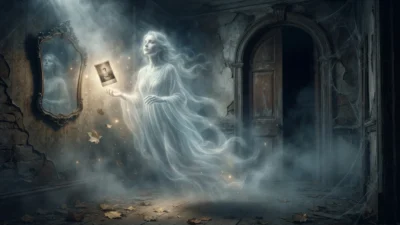
- Floating figures
- Transparent forms
- Light
- Smoke
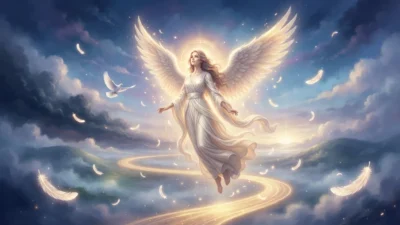
- Wings
- Fire
- Birds
- Halos
- Clouds
- Glowing shapes
These images can make an invisible concept visually understandable.
Dream Meaning of Spirit Symbolism
Dreams involving spirits can feel mysterious, emotional, or intense. Their meaning depends heavily on the dreamer’s personal beliefs, experiences, emotions, and cultural background.
A peaceful spirit in a dream may symbolize comfort, acceptance, guidance, or emotional calm.
A frightening spirit may represent fear, unresolved feelings, uncertainty, or something from the past that still affects the dreamer.
A guiding spirit may symbolize intuition, wisdom, or the desire for direction.
Common Spirit-Related Dream Symbols
| Dream Symbol | Possible Symbolic Meaning |
|---|---|
| Peaceful spirit | Comfort, acceptance, inner peace |
| Frightening spirit | Fear, uncertainty, unresolved emotions |
| Guiding spirit | Wisdom, intuition, direction |
| Glowing spirit | Hope, spiritual awareness |
| Departing spirit | Change, endings, letting go |
| Returning spirit | Memories, unresolved experiences |
| Spirit in nature | Connection, freedom, renewal |
| Talking spirit | Reflection, advice, or an inner concern |
Dream symbolism is personal rather than universal. A spirit that feels frightening to one person may feel comforting to another.
Modern Meaning of Spirit Symbolism
Today, the word spirit has both religious and everyday meanings.
Someone may talk about spirituality, spiritual energy, inner strength, community spirit, or the human spirit without necessarily following a specific religion.
The Human Spirit
The phrase human spirit commonly represents resilience, courage, hope, compassion, and the ability to overcome hardship.
It is often used when people demonstrate extraordinary strength during difficult circumstances.
Free Spirit
A free spirit is someone who values independence and does not easily follow conventional expectations.
The phrase gives spirit a modern symbolic meaning connected with freedom, individuality, creativity, and authenticity.
Community Spirit
Spirit can also describe the energy shared by a group.
“Community spirit” represents cooperation, belonging, generosity, and collective identity.
This shows that spirit symbolism is not limited to individual spirituality. It can also represent the invisible bonds that connect people.
Spirituality and Personal Growth
Modern spirituality often emphasizes self-awareness, mindfulness, purpose, gratitude, and connection.
In this setting, spirit symbolism can represent the search for a meaningful life rather than a specific supernatural belief.
Spirit Symbolism and Personal Growth
Spirit symbolism can be understood as a journey toward becoming stronger, wiser, and more authentic.
Difficult experiences may test a person’s spirit. Reflection can create understanding, while understanding can lead to growth.
A simple symbolic progression is:
Challenge → Reflection → Resilience → Wisdom → Transformation
This is why expressions such as “strong spirit” and “indomitable spirit” are so powerful. They suggest that circumstances may affect the body or emotions without completely destroying a person’s inner strength.
Spirit Symbolism at a Glance
| Symbolic Meaning | What It Represents |
|---|---|
| Life force | Energy, vitality, existence |
| Freedom | Independence and authenticity |
| Courage | Strength during hardship |
| Spirituality | Connection with the sacred |
| Guidance | Intuition and direction |
| Inspiration | Creativity and motivation |
| Transformation | Personal or spiritual change |
| Peace | Inner calm and harmony |
| Divine connection | Relationship with a higher power |
| Resilience | Ability to endure and recover |
| Mystery | The unseen and unknown |
| Community | Shared identity and collective energy |
Common Symbols Associated With Spirit
Certain images frequently appear in spiritual and cultural symbolism.
Dove
The dove can represent peace, purity, hope, and, in Christianity, the Holy Spirit.
Wind
Wind symbolizes an invisible force that can nevertheless produce visible effects. It can represent breath, change, freedom, or spiritual movement.
Fire
Fire often represents spiritual energy, passion, purification, renewal, and transformation.
Wings
Wings commonly symbolize freedom, transcendence, elevation, and movement beyond physical limitations.
Light
Light can represent truth, hope, knowledge, divine presence, and spiritual awakening.
Breath
Because breathing is closely connected with life, breath can symbolize spirit, vitality, and the mystery of existence.
Frequently Asked Questions About Spirit Symbolism
What does spirit symbolism represent?
Spirit symbolism commonly represents life force, inner identity, spiritual energy, freedom, courage, guidance, and connection with the unseen or sacred.
What is the spiritual meaning of spirit?
Spirit can symbolize a person’s connection with a higher power, inner awareness, purpose, intuition, and spiritual transformation.
What does a spirit symbolize in dreams?
A spirit in a dream may represent memories, fears, guidance, unresolved emotions, spiritual questions, or personal transformation. Its meaning depends on the dreamer’s feelings and circumstances.
What symbols represent the spirit?
Common spirit symbols include wind, fire, birds, wings, light, breath, and doves. Their meanings vary according to culture and religious tradition.
What does the human spirit symbolize?
The human spirit commonly symbolizes resilience, courage, hope, determination, compassion, and the ability to endure difficult experiences.
Conclusion
Spirit symbolism gives meaning to something that cannot easily be seen or measured. It can represent life energy, inner identity, freedom, courage, spiritual awareness, divine connection, and the mysterious forces that shape human experience.
Across religion, history, culture, literature, art, dreams, and modern life, spirit remains a powerful symbol of what lies beyond the physical surface. Whether understood spiritually or metaphorically, it often reminds us of an enduring human idea: strength, meaning, and connection can exist in places we cannot see.