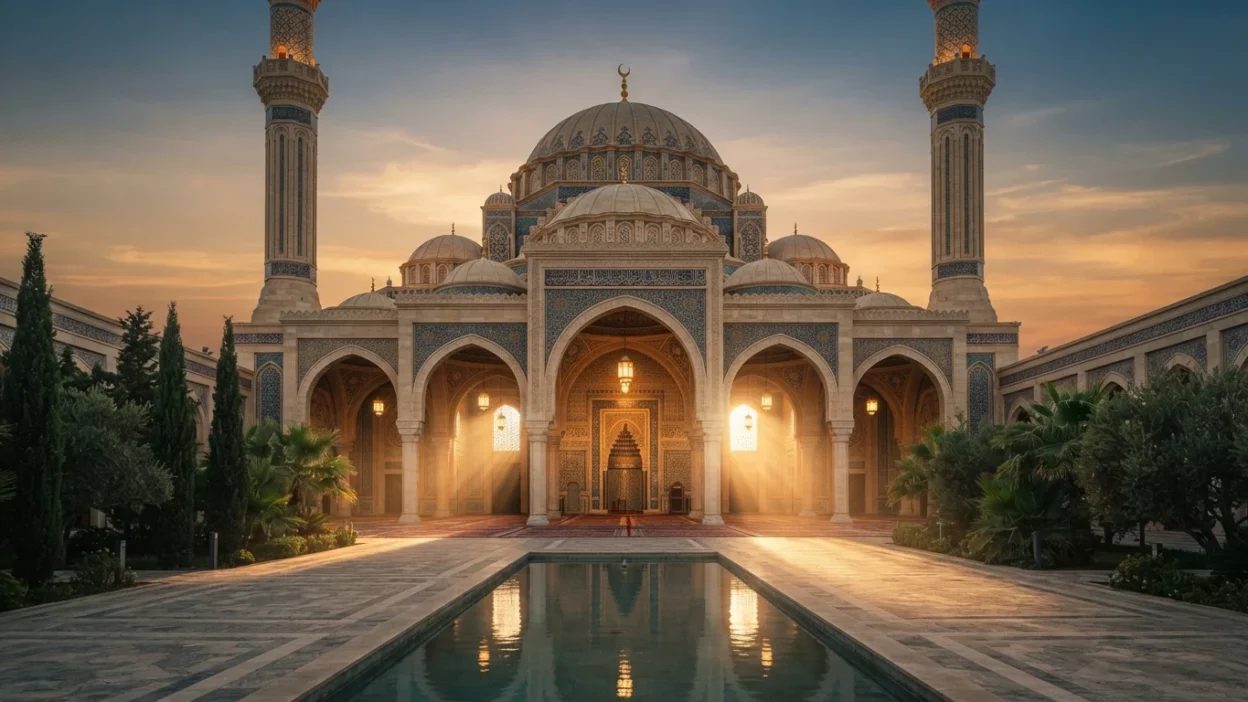
Mosque symbolism gives spiritual meaning to the architecture, spaces, patterns, objects, and traditions found in Muslim places of worship. From the direction of the qibla to the mihrab, minaret, dome, calligraphy, light, water, and geometric designs, mosque features can express devotion, unity, humility, and remembrance of Allah.
A mosque is more than a building. It is a place for prayer, reflection, learning, community, and spiritual connection. Its design often encourages worshippers to leave behind everyday distractions and turn their attention toward God.
Mosque Symbolism Meaning (Clear Definition)
Mosque symbolism is the religious and cultural meaning expressed through mosque architecture, decoration, spatial design, calligraphy, geometric patterns, and worship practices.
Unlike a single fixed symbol, mosque symbolism is a combination of visual and spatial elements shaped by Islamic teachings and the cultures in which mosques are built.
Some features have especially recognizable meanings:
| Mosque Element | Common Symbolic Meaning |
|---|---|
| Mihrab | Direction of prayer and focus of worship |
| Qibla | Orientation toward the Kaaba in Makkah |
| Minaret | Call to prayer and visible Muslim identity |
| Dome | Spaciousness, heavenly aspiration, and architectural unity |
| Prayer hall | Congregational worship and equality |
| Water | Purification and preparation for prayer |
| Islamic calligraphy | Reverence for the Quran and remembrance of Allah |
| Geometric patterns | Order, balance, unity, and infinite creation |
| Courtyard | Community, openness, reflection, and gathering |
| Light | Guidance, knowledge, and spiritual awareness |
Not every mosque contains all of these features, and their meanings can vary according to region, architectural tradition, and historical period.
What Does Mosque Symbolism Represent?
Mosque symbolism represents central values of Islamic worship and community life. Common themes include devotion, unity, humility, purity, guidance, knowledge, and remembrance of Allah.
Unity
One of the strongest ideas expressed by mosque spaces is unity.
Muslims from different social backgrounds stand together in rows during congregational prayer. The arrangement emphasizes that worshippers are equal before God.
Direction and Devotion
The qibla gives worship a shared direction.
Regardless of where a mosque is located, Muslims face toward the Kaaba in Makkah during formal prayer. This shared orientation creates a powerful sense of spiritual connection across the global Muslim community.
Humility
Mosque interiors are often designed to encourage calmness and concentration rather than personal display.
Removing shoes, maintaining cleanliness, sitting or kneeling in prayer, and standing together with others can reinforce ideas of humility and reverence.
Knowledge and Remembrance
Mosques have historically served as places not only for prayer but also for teaching and learning.
Quranic calligraphy, inscriptions, libraries, lectures, and study areas can emphasize the importance of knowledge and remembrance.
Peace and Reflection
The quiet atmosphere of a mosque can provide a space away from the noise of everyday life.
Courtyards, gardens, fountains, natural light, and carefully arranged interiors may encourage contemplation and peaceful reflection.
Spiritual Meaning of Mosque Symbolism
The spiritual meaning of mosque symbolism centers on worship, submission to God, remembrance, community, and the pursuit of a life guided by faith.
A mosque’s architecture can support the mental transition from ordinary activities to prayer.
The Mosque as a Sacred Space
A mosque provides a dedicated environment for worship.
Although Islamic tradition does not require Muslims to worship only inside mosques, the mosque creates a shared setting where individuals and communities can gather for prayer and religious activities.
The Mihrab and Spiritual Focus
The mihrab is a niche or architectural feature in a mosque that indicates the direction of prayer.
It helps establish the qibla and often becomes a visual focal point within the prayer hall.
Its symbolism is therefore strongly connected with orientation, worship, and concentration.
Water and Purification
Water has an important role in Islamic religious practice.
Before prayer, Muslims may perform wudu, a ritual purification involving washing specific parts of the body. Mosque fountains or ablution areas can therefore represent cleanliness and preparation for worship.
Light and Guidance
Light is frequently used in Islamic architecture to create beauty and atmosphere.
Beyond its physical function, light can evoke ideas of guidance, knowledge, clarity, and spiritual awareness. The symbolic interpretation of light varies according to context, but it is a recurring theme in Islamic art and architecture.
Biblical / Religious Meaning of Mosque Symbolism
The biblical tradition is not the appropriate framework for understanding mosque symbolism. Mosque symbolism is rooted primarily in Islamic beliefs, the Quran, Hadith traditions, Islamic history, and the diverse cultures of Muslim communities.
The mosque itself is associated with worship and remembrance of Allah. The Arabic term masjid is related to the idea of prostration, reflecting the act of bowing or prostrating oneself in worship.
The Kaaba and Qibla
The Kaaba in Makkah holds a central place in Islamic worship.
Muslims around the world face the Kaaba’s direction during salah. This orientation creates a remarkable visual and spiritual connection between mosques across different countries.
The Mihrab
The mihrab identifies the qibla direction inside a mosque.
It became an important architectural feature in Islamic history and can be richly decorated with tilework, stone, wood, calligraphy, or geometric patterns.
The Minbar
The minbar is a raised platform traditionally associated with the sermon delivered during Friday congregational prayer.
It can symbolize teaching, guidance, religious instruction, and community leadership.
Calligraphy and Quranic Text
Islamic calligraphy has a particularly important role in mosque decoration.
Arabic script may be used to display Quranic verses, religious phrases, or other devotional inscriptions. Because of the significance of the Quran in Islam, written sacred language can become both an artistic and spiritual element.
Avoiding Images of Divine Representation
Many Islamic artistic traditions emphasize calligraphy, geometry, arabesque patterns, and architecture rather than images of God.
This has encouraged highly sophisticated decorative traditions in which visual beauty is created through proportion, repetition, script, plant forms, and geometry.
Mosque Symbolism in History and Culture
Mosque architecture developed across many regions, including the Middle East, North Africa, Central Asia, South Asia, Southeast Asia, Europe, and other parts of the world.
As Islam spread, local building traditions influenced mosque design. This is why mosques can look dramatically different while serving similar religious functions.
Early Mosque Architecture
Early mosques often emphasized practical spaces for congregational prayer.
The prayer hall, courtyard, qibla orientation, and areas for community activity became important elements of mosque planning.
Ottoman Mosque Symbolism
Ottoman architecture became famous for large central domes, elegant minarets, spacious interiors, and carefully balanced proportions.
The monumental scale of these structures can create a powerful sense of openness and awe.
Persian and Central Asian Traditions
Persianate mosque architecture developed distinctive tilework, domes, courtyards, arches, and intricate geometric and floral decoration.
Colorful surfaces can transform architecture into an immersive visual experience.
South Asian Mosque Architecture
South Asian mosques often combine Islamic architectural principles with regional artistic traditions.
Domes, arches, minarets, courtyards, calligraphy, stone carving, tilework, and decorative patterns can appear in many different combinations.
African and Other Regional Traditions
Mosque architecture also developed distinctive forms in West Africa, East Africa, Southeast Asia, China, and other regions.
Local materials, climate, construction methods, and artistic traditions shaped the appearance of individual mosques.
This diversity is an important part of mosque symbolism because it demonstrates how Islamic worship can exist within many cultural environments.
Mosque Symbolism in Literature and Art
Mosques have appeared in literature, painting, photography, poetry, film, and architectural art for centuries.
Artists often use mosque imagery to communicate themes of spirituality, identity, memory, community, beauty, and cultural heritage.
The Minaret as a Symbol
A minaret rising above a city can become a recognizable symbol of Muslim presence.
In literature and visual art, it may represent home, faith, community, or a connection with a particular cultural landscape.
The Dome as a Visual Motif
A mosque dome can symbolize grandeur, shelter, spaciousness, or spiritual aspiration.
Artists may emphasize its curved form against the sky to create a sense of transcendence.
Calligraphy as Sacred Art
Islamic calligraphy combines language and visual beauty.
A Quranic inscription may communicate a religious message while also becoming an important component of architectural design.
Geometric Patterns
Geometric patterns are among the most recognizable elements of Islamic art.
Repeating shapes can create visual harmony and suggest ideas of order, balance, interconnectedness, and the complexity of creation.
Dream Meaning of Mosque Symbolism
Dreams involving mosques can have deeply personal meanings, particularly for people who associate mosques with faith, family, community, or important memories.
Possible interpretations include:
- Entering a mosque: Seeking peace, guidance, spiritual connection, or a sense of belonging.
- Praying in a mosque: Reflection, devotion, repentance, gratitude, or a desire for reassurance.
- Seeing a beautiful mosque: Inspiration, hope, inner harmony, or appreciation of spiritual values.
- An empty mosque: Loneliness, spiritual questioning, nostalgia, or a desire for connection.
- A damaged mosque: Concerns about faith, community, personal values, or significant change.
- Hearing the call to prayer: A reminder, awakening, spiritual responsibility, or an important transition.
- Cleaning a mosque: Purification, service, responsibility, or a desire to restore order.
Dream interpretation is not a fixed religious rule. The meaning of a mosque in a dream depends on the dreamer’s experiences, emotions, beliefs, and circumstances.
Modern Meaning of Mosque Symbolism
Modern mosques continue to serve as places of prayer, education, charity, community gathering, and spiritual reflection.
Their architecture also expresses Muslim identity in contemporary cities.
Modern mosque designers may combine traditional elements such as domes, minarets, courtyards, arches, and geometric patterns with modern materials, sustainable technologies, open layouts, and minimalist designs.
Mosques as Community Centers
A mosque may provide more than a prayer space.
Many mosques support educational programs, charitable activities, social gatherings, family events, and community services.
This reinforces the idea that a mosque can represent both spiritual devotion and communal responsibility.
Modern Islamic Architecture
Contemporary mosque architecture demonstrates that symbolism does not have to remain visually traditional.
Natural light, innovative geometric structures, sustainable materials, gardens, and modern interpretations of Islamic patterns can communicate similar themes through new architectural languages.
Cultural Identity
For Muslim communities living far from historically Islamic regions, a mosque can become an important symbol of cultural identity and belonging.
Its presence can connect people with religious traditions while also becoming part of the surrounding community.
Common Mosque Symbols and Their Meanings
The following symbols and features are among the most recognizable elements associated with mosque architecture and Islamic visual culture:
- Mihrab: Indicates the direction of prayer and creates a focal point in the prayer space.
- Qibla: Represents the shared direction toward the Kaaba in Makkah.
- Minaret: Traditionally associated with the call to prayer and the visible presence of the mosque.
- Dome: Creates architectural emphasis and can suggest spaciousness or heavenly aspiration.
- Minbar: Represents religious teaching and the Friday sermon.
- Calligraphy: Expresses reverence for Quranic language and Islamic teachings.
- Geometric patterns: Suggest order, balance, repetition, and visual harmony.
- Water: Represents purification and preparation for worship.
- Courtyard: Provides space for gathering, movement, reflection, and sometimes prayer.
- Arabesque designs: Use flowing plant-like forms to create rhythmic decorative patterns.
These elements should not be treated as having identical meanings in every mosque. Islamic architecture is remarkably diverse.
Why Is Mosque Symbolism Important?
Mosque symbolism is important because it connects physical space with spiritual practice.
A prayer hall can express unity. A mihrab establishes direction. Water supports purification. Calligraphy communicates sacred language. Geometric patterns create visual order. A minaret can make the mosque recognizable within a city.
Together, these elements create an environment that encourages worship and remembrance.
Mosque architecture also preserves history. A centuries-old mosque can tell the story of a community through its materials, artistic techniques, inscriptions, architectural style, and relationship with the surrounding city.
Frequently Asked Questions About Mosque Symbolism
What is the main meaning of mosque symbolism?
Mosque symbolism expresses Islamic beliefs and values through architecture, decoration, spatial arrangement, calligraphy, and religious practices. Common themes include worship, unity, purity, guidance, humility, and remembrance of Allah.
What does a mosque symbolize spiritually?
A mosque symbolizes a place dedicated to worship, prayer, reflection, learning, and community. It can also represent spiritual connection, submission to God, peace, and unity among Muslims.
What does the dome of a mosque symbolize?
A mosque dome can emphasize the centrality and openness of the prayer space and create an upward visual movement. Its specific symbolism varies across architectural traditions rather than having one universally fixed meaning.
Why do mosques have minarets?
Minarets historically provided a prominent place associated with the call to prayer and became recognizable features of mosque architecture. Today, their functions and forms vary considerably between regions and individual mosques.
What does a mihrab symbolize in a mosque?
The mihrab marks the direction of prayer, known as the qibla. It often becomes the visual focus of the prayer hall and reinforces the worshipper’s orientation toward the Kaaba in Makkah.
Conclusion
Mosque symbolism shows how Islamic faith can be expressed through architecture, light, geometry, calligraphy, water, direction, and communal space. Every region has developed its own architectural language, yet many mosques share themes of worship, unity, humility, purity, knowledge, and remembrance.
From the quiet mihrab to the soaring minaret and intricate geometric patterns, mosque architecture invites people to look beyond physical beauty toward the spiritual values it represents. In this way, the mosque becomes not simply a building, but a meaningful expression of faith and community.